







Corcel Exploration Inc. (CSE: CRCL) (OTCQB: CRLEF) (FSE: Y67) is pleased to announce the final assay results from the recently completed Phase I drill program at the Yuma King Project located in west-central Arizona. The initial campaign successfully completed 1,087 meters across six drill holes with copper and gold in each drill hole.
Highlights
“Phase I has significantly advanced our understanding of Yuma King and highlighted the potential for a much larger copper-gold system,” commented Jon Ward, CEO of Corcel Exploration. “We have demonstrated continuity of copper-gold skarn mineralization, intersected additional mineralized skarn at depth, and encountered strongly anomalous copper, gold and molybdenum within the associated porphyritic intrusions. Together, these results expand the prospective skarn footprint and provide compelling vectors toward a potentially concealed porphyry system.
With mineralization remaining open under cover to the north and northwest toward the North Skarn target, and additional untested targets at Yuma King West and Three Musketeers, Phase I has provided us with several compelling targets to advance and test during a Phase II exploration program.”
2026 Yuma King Drill Program
The Phase I drill program successfully expanded the exploration footprint at the Yuma King Project. The skarn-related mineralization intersected in YK26-006 shows evidence that the mineralized skarn may be structurally duplicated by folding or faulting, or that numerous skarn-hosting horizons may be present, increasing the prospective footprint of the target area. In addition, strongly anomalous copper, molybdenum, and gold in porphyritic intrusions in these holes suggests a vector towards a possible concealed porphyry system at depth and/or to the north (Figure 1, Table 2).
Drill hole YK26-004 was designed to intersect mineralization to the north and below the historical mine workings. The hole was drilled toward the northwest at a dip of -70°. The drill hole intersected a void, presumed to be unmapped historical workings, and was lost. The assays revealed copper and gold increasing and intersected faulted skarn adjacent to the void. Single sample assays range up to 0.63% Cu, 0.27 g/t Au, and 5.4 g/t Ag over 0.75m within 10m of where the hole was lost.
Drill hole YK26-005A was drilled 160 meters to the northeast of YK26-001 and was drilled towards the south at a dip of -55°. The drill hole intersected 8.97 meters of 0.46% Cu, 0.39 g/t Au, and 3.8 g/t Ag1 (Table 1) beginning at 116 meters down hole. This mineralization is hosted in a faulted zone which includes slices of mineralized skarn sandwiched between a strongly propylitic and quartz-sericite-pyrite altered monzonite porphyry and a less-altered feldspar porphyry. Stockwork and sheeted quartz and quartz-pyrite veins are present within the interval. The hanging wall altered monzonite porphyry is strongly anomalous in copper, gold, and molybdenum (47.42 meters of 0.09% Cu, 0.06 g/t Au, and 215 ppm Mo). The hole ended at 245m depth within the footwall feldspar porphyry intrusion.
Drill hole YK26-006 was collared 175-meters to the east of YK26-001 and drilled toward the northeast at a dip of -50°. The primary objective of the hole was to test part of an induced polarization (IP) anomaly identified during the survey conducted earlier this year, as well as evaluate the mineralization and porphyry potential at depth to the northeast. The drill hole intersected two mineralized skarn zones, separated by a thick interval of variably propylitic, quartz-sericite-pyrite, and possibly patchy potassic altered or hematite-stained, possibly multi-stage monzonite porphyry intrusion(s). The upper oxide zone was encountered at a downhole depth of 28.05 and returned 4.4 meters of 0.71% Cu, 0.19 g/t Au, and 8.5 g/t Ag1. The lower sulfide zone began at a downhole depth of 212 meters and returned 24.5 meters of 0.46% Cu, 0.32 g/t Au, and 3.9 g/t Ag1 (Table 1). Between these two skarn intervals in drill hole YK26-006, the intervening monzonite porphyry returned consistently anomalous copper, gold, and molybdenum values (individual samples up to 0.22% Cu, 0.24 g/t Au, and 1100 ppm Mo within 150.7m of 608 ppm Cu, 0.04 g/t Au, and 180 ppm Mo). The monzonite porphyry between the mineralized zones features sheeted quartz and sulfide veinlets.
The deeper intersection of mineralized skarn in drill hole YK26-006 suggests that the skarn horizon may be structurally repeated, likely by folding, significantly expanding the prospective target area and highlighting additional exploration potential. The strongly anomalous copper-gold-molybdenum signature of the associated monzonite porphyry supports the interpretation that the system is related to a porphyry system nearby, most likely under cover to the north, northwest, or northeast.
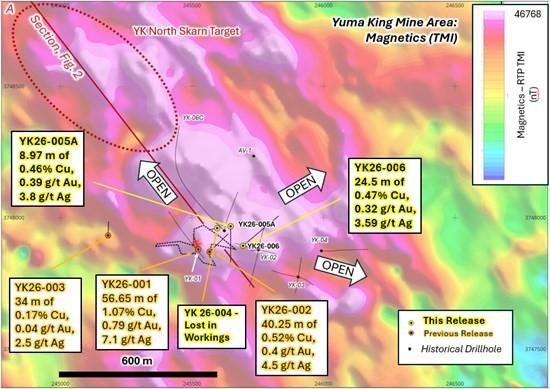
Figure 1. Map showing the collar location of drill holes YK26-005A and YK26-006, in relation to recently completed holes and to historical drill holes. Location of historical underground workings is shown projected to surface.
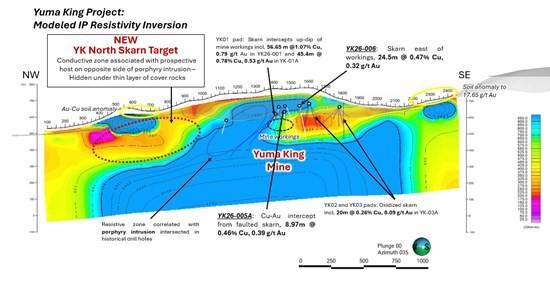
Figure 2. Section showing the IP resistivity with down-hole assay results from historical drill holes and YK26-005A and YK26-006 that show mineralization at depth
Table 1. Assay results from the Phase I Drill Program
| Drillhole | Intercept From – To (m) | Intercept Thickness1 (m) | Cu (%) | Au (g/t) | Ag (g/t) | Mo (ppm) | |
| YK26-001* | 3.35 | 60 | 56.65 | 1.07 | 0.79 | 7.1 | 180 |
| including | 24 | 31.85 | 7.85 | 2.28 | 1.14 | 6.8 | 266 |
| including | 45 | 53.8 | 8.8 | 2.07 | 1.85 | 20.5 | 312 |
| YK26-002* | 30 | 70.25 | 40.25 | 0.52 | 0.4 | 4.49 | 85 |
| including | 44.25 | 53 | 8.75 | 0.74 | 0.46 | 3.72 | 46 |
| including | 54.4 | 70.25 | 15.85 | 0.7 | 0.59 | 8.1 | 152 |
| YK26-003* | 25 | 57 | 32 | 0.174 | 0.04 | 2.47 | 25 |
| including | 33 | 42 | 9 | 0.25 | 0.09 | 3.5 | 7 |
| including | 46.6 | 53.93 | 7.33 | 0.3 | 0.04 | 4.2 | 107 |
| YK26-004 | 81.98 | 89 | 7.02 | 0.16 | 0.06 | 1.4 | 264 |
| YK26-005A | 68.58 | 116 | 47.42 | 0.09 | 0.06 | 0.43 | 215 |
| and | 116 | 124.97 | 8.97 | 0.46 | 0.39 | 3.77 | 250 |
| YK26-006 | 28.05 | 32.45 | 4.4 | 0.71 | 0.19 | 8.46 | 5 |
| and | 50.29 | 201 | 150.71 | 0.06 | 0.03 | 0.5 | 182 |
| and | 212 | 236.5 | 24.5 | 0.47 | 0.32 | 3.59 | 164 |
| including | 219.21 | 229.35 | 10.14 | 0.65 | 0.47 | 4.73 | 141 |
*From previous news release dated June 1, 2026, and July 13, 2026
Table 2. Collar information for Phase I drill program
| Drillhole | Easting | Northing | Elevation | Azimuth | Dip | Total Depth |
| YK26-001 | 245524 | 3747879 | 640.77 | 341 | -50 | 91.74 |
| YK26-002 | 245567 | 3747870 | 650.38 | 46 | -50 | 152.4 |
| YK26-003 | 245181 | 3747932 | 609.42 | 2 | -60 | 103.3 |
| YK26-004 | 245596 | 3747960 | 690.35 | 258 | -70 | 92.96 |
| YK26-005^ | 245647 | 3747967 | 691.33 | 180 | -55 | 127.41 |
| YK26-005A | 245647 | 3747967 | 691.33 | 180 | -55 | 245.36 |
| YK26-006 | 245694 | 3747893 | 700.42 | 50 | -50 | 274.32 |
^Hole lost and re-drilled as YK26-005A and was not sampled.
Sampling, Quality Assurance/Quality Control
All sampling was conducted under the supervision of Corcel’s geologists, and all drill core analytical results have been monitored through the Company’s quality assurance and quality control program (QA/QC). The drill core was sawn in half at Corcel’s dedicated and secure core logging and processing facility near Parker, Arizona.
Half of the drill core was sampled and shipped by a bonded courier in sealed and secured woven polyester bags to Agat Laboratories in Calgary, Alberta. Core samples were prepared using standard preparation procedures 200-078 and 200-087 which involve crushing the sample to 80% less than 2mm, followed by a riffle split of 250g, and then a pulverised split to better than 85%, passing 75 microns.
Following sample preparation, the pulps were sent to the Agat Laboratories in Calgary, Alberta for analysis. Agat is registered to ISO/IEC 17025:2017 accreditations for laboratory procedures.
Drill core samples were analyzed for 48 elements, including Cu, Ag, Mo by ICP-OES/MS on a 0.2-gram aliquot using a four-acid digestion (method 201-071 and 201-470 for over-limit results). Gold was analyzed by fire assay on a 50-gram aliquot with an AAS (Atomic Absorption Spectroscopy) finish (method 202-551).
In addition to Agat Laboratories QA/QC protocols, Corcel implements a rigorous internal QA/QC program that includes the insertion of field and lab duplicates, certified reference materials (standards prepared by an independent lab) and blanks into the sample stream. Data verification of the analytical results includes a statistical analysis of the standards and blanks that must pass certain parameters for acceptance to ensure accurate and verifiable results, and the procedures and results are considered acceptable.
Technical Disclosure
Roy Greig, Ph.D., P.Geo., a Qualified Person as defined in National Instrument 43-101 Standards of Disclosure for Mineral Projects, and advisor to the Company, has reviewed and approved the scientific and technical information contained in this news release. Historical information referenced herein has not been independently verified by the Company’s Qualified Person. The Company considers this information relevant for exploration targeting purposes, but readers should not place undue reliance on such historical information.
About Corcel Exploration Inc.
Corcel Exploration is a mineral resource company engaged in the acquisition and exploration of precious and base metals properties throughout North America. The Company has entered a long-term lease agreement to acquire the Yuma King Cu-Au project in Arizona, which spans a district-scale land position of 3,200 hectares comprising 515 unpatented federal mining claims in the Ellsworth Mining District, including the past-producing Yuma King Mine which saw underground production of copper, lead, gold and silver between 1940 and 1963.
Brutus Mining Inc. (CSE: BRU) (FSE: ZI3) is pleased to announce that it has closed its non-brokered ... READ MORE
Jaguar Uranium Corp. (NYSE American: JAGU) is pleased to announce an independent Mineral Resource E... READ MORE
Auro Metals Inc. (TSX-V: AURO) (OTCQB: AURFF), is pleased to announce the assay results of the fina... READ MORE
Endeavour Silver Corp. (NYSE: EXK) (TSX: EDR) is pleased to announce that repairs to the primary bal... READ MORE
Scorpio Gold Corp. (NASDAQ: SGLD) (TSX-V: SGLD) (OTCQB: SRCRF) (FSE: RY9) is pleased to announce re... READ MORE