







Africa’s largest copper smelter produced 112,307 tonnes of high-strength sulphuric acid; July contracts priced at approximately $840 per tonne
Copper production rate set to increase in H2 2026, driven by 30% increase in Kamoa mining rate to 8.5 Mtpa
Project 95 complete; Kamoa-Kakula’s Phase 1 and 2 concentrator recovery rates set to be boosted from Q3 2026
Commissioning of Kamoa-Kakula’s 60-MW solar facility with battery backup underway; ramping up to full capacity by end of Q3 2026
Kipushi produced a record 70,177 tonnes of zinc in concentrate in Q2 2026, a quarterly increase of 8%
Ramp up of Platreef’s new Shaft #3 complete; Phase 2 expansion on target for Q4 2027 completion
Western Forelands Mineral Resource update expected mid-July
Ivanhoe to issue Q2 2026 financial results after market close on July 29; host conference call for investors on July 30
Ivanhoe Mines’ (TSX: IVN) (OTCQX: IVPAF) Executive Co-Chair Robert Friedland and President and Chief Executive Officer Marna Cloete announced today the company’s second-quarter production results and an update on operational and project activities.
Kamoa-Kakula produced 64,328 tonnes of copper in Q2 2026; improved mining rates and destocking of copper inventories set to significantly boost H2 2026 copper production
Summary of quarterly production data from Kamoa-Kakula
| Phase 1 & 2 concentrators | Q2 2025 | Q3 2025 | Q4 2025 | Q1 2026 | Q2 2026 |
| Ore milled (000’s tonnes) | 1,991 | 1,838 | 1,712 | 1,534 | 1,387 |
| Feed grade of ore processed (% copper) | 4.12% | 2.50% | 2.32% | 2.35% | 2.59% |
| Copper recovery (%) | 85.4% | 81.3% | 83.2% | 84.1% | 86.6% |
| Copper in concentrate produced (tonnes) | 71,401 | 37,744 | 34,602 | 30,527 | 30,211 |
| Phase 3 concentrators | |||||
| Ore tonnes milled (000’s tonnes) | 1,631 | 1,618 | 1,662 | 1,574 | 1,582 |
| Feed grade of ore processed (% copper) | 2.92% | 2.44% | 2.38% | 2.28% | 2.22% |
| Copper recovery (%) | 85.5% | 84.2% | 88.2% | 87.2% | 88.2% |
| Copper in concentrate produced (tonnes) | 40,608 | 33,522 | 34,814 | 31,379 | 30,923 |
| Combined Phase 1, 2, and 3 concentrators | |||||
| Ore tonnes milled (000’s tonnes) | 3,622 | 3,456 | 3,374 | 3,108 | 2,968 |
| Feed grade of ore processed (% copper) | 3.58% | 2.47% | 2.35% | 2.32% | 2.39% |
| Copper recovery (%) | 85.4% | 82.7% | 85.7% | 85.6% | 87.4% |
| Copper in concentrate produced (tonnes) | 112,009 | 71,266 | 69,419 | 61,906 | 61,134 |
| Smelter(1) | |||||
| Contained copper in anode, blister or concentrate for sale (000’s tonnes) | 71,417 | 64,328 | |||
| High-strength sulphuric acid (000’s tonnes) | 117,871 | 112,307 | |||
Data in bold denotes a quarterly record.
(1) copper production from Kamoa-Kakula’s on-site smelter, as well as Kamoa-Kakula concentrate toll-treated at the LCS smelter in Kolwezi. ‘Concentrate for sale’ is slag concentrate produced by Kamoa-Kakula’s smelter that is sold to third parties and not reprocessed by either the on-site smelter or LCS.
During the second quarter, the Phase 1, 2, and 3 concentrators milled 2.97 million tonnes of ore, producing 61,134 tonnes of copper in concentrate. Kamoa-Kakula’s copper smelter produced 62,072 tonnes of anode, and the Lualaba Copper Smelter (LCS) produced 2,256 tonnes of copper in blister, for a total of 64,328 tonnes of copper produced in anode, blister or saleable slag concentrate by Kamoa-Kakula during the quarter. The decline in copper blister production was due to a 56-day shutdown of LCS during the quarter. LCS resumed normal operations on July 1, 2026.
Copper held in inventory remained unchanged during the quarter at approximately 40,000 tonnes of copper. The planned destocking of up to 10,000 tonnes of copper held in inventory will now take place during H2 2026.
At the start of 2026, approximately 50,000 tonnes of copper were in inventory on-site at Kamoa-Kakula and at LCS. At the end of the second quarter, there were approximately 40,000 tonnes of contained copper in inventory, which was unchanged from the end of the first quarter. Kamoa-Kakula management is targeting a year-end inventory of between 25,000 and 30,000 tonnes of copper.
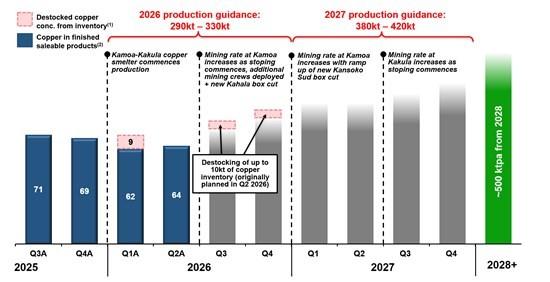
Figure 1. Planned growth in quarterly copper production at Kamoa-Kakula (‘000 tonnes).
Notes: Figures shown on a 100% basis. Bars in grey are an indication of forecasted quarterly copper production and are not official guidance
(1) At the start of 2026, there were approximately 50,000 tonnes of copper contained in concentrate held in inventory. Excess inventory to be destocked during 2026.
(2) 2025 production is reported as contained copper in concentrate. Production reported from 2026 onwards is reported as copper in anode, blister or slag concentrate held for sale.
Copper production in H2 2026 is set to increase following improved mining rates at Kamoa; additional mined ore to supply Phase 1 and 2 concentrators
2026 production guidance is maintained at 290,000 to 330,000 tonnes of copper in anode or blister. Copper production in H2 2026 is expected to be boosted by both higher mining rates across the Kamoa mines (Kamoa 1 and Kansoko), as well as the destocking of copper concentrates held in inventory.
In H2 2026, mining rates across the Kamoa mines are planned to increase by 30% to 700,000 tonnes per month, equivalent to approximately 8.5 million tonnes per annum (Mtpa). The increase is driven by the mobilization of additional mining crews and the commencement of stoping (production mining). In addition, new access to the Kamoa Mine was recently achieved via the Kahala box cut, the decline of which has been developing in ore since June.
Another decline is under development at the Kamoa mines, called Kansoko Sud. Construction of the Kansoko Sud box cut was completed in Q2 2026, with twin declines currently being developed. A further 700 metres of decline development is required before reaching the orebody, which is expected in Q1 2027.
During the second quarter, the Phase 1 and 2 concentrators were campaigned, or batch operated, due to reduced ore availability from Kakula. With greater ore availability expected in H2 2026 from both Kakula and Kamoa, utilization of the Phase 1 and 2 concentrators is expected to increase.
Ore feed into the Phase 1 and 2 concentrators in H2 2026 will continue to come predominantly from the western side of Kakula at a rate of approximately 400,000 tonnes per month, or 4.8 Mtpa annualized, at a grade of approximately 2.7% copper. In addition, with the mining rate at Kamoa expected to increase from 6.5 Mtpa to 8.5 Mtpa by the end of Q3 2026, the additional 2 Mtpa of ore mined, at an average grade of 2.5% copper, will be processed by the Phase 1 and 2 concentrators.
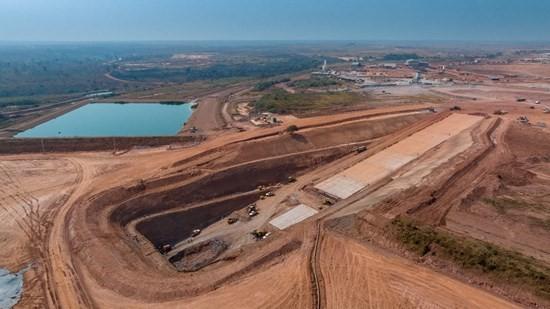
Looking southeast over the construction of the new Kahala box cut, with the operational Kamoa 1 box cut in the background (top right). During Q3 2026, the mining rate of the Kamoa mines is expected to increase by 30% following the deployment of additional mining crews, an increase in stoping (production mining) and the completion of the new Kahala box cut.
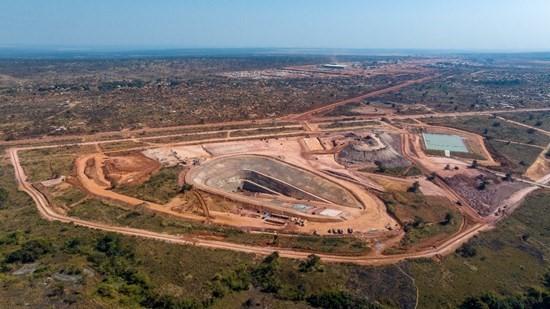
Looking north over the newly constructed Kansoko Sud box cut, which is expected to start underground development in ore from Q1 2027. The new box cut will support the increase in production to between 380,000 and 420,000 tonnes of copper in 2027.
Underground development rates at Kamoa and Kakula are advancing in line with the plan, positioning the complex for a production rate of approximately 500,000 tonnes of copper per annum from 2028
As announced on March 31, 2026, the 2026 Kamoa-Kakula Mineral Reserve Estimate outlines an updated mine plan for the Kamoa-Kakula Copper Complex to ramp up production to approximately 500,000 tonnes of copper per annum from 2028 onwards. This includes operating the Phase 1, 2 and 3 concentrators at a steady-state rate of 17 million tonnes per annum over approximately 25 years.
At both the Kamoa and Kakula underground mines, development activities over the next 18 months are focusing on establishing long-term access and mine services ahead of stoping (production mining). Production stoping has recently started at Kamoa, while stoping at Kakula is expected to commence in H2 2027. Over the next 9-12 months, ore mined at Kakula will be solely from development. Development is focused on establishing peripheral access drives in lower-grade areas around the edges of the orebody, before stoping in the newly developed, high-grade mining areas can begin.
Year-to-date, development rates are advancing in line with the plan, as outlined in Figure 2, notably including a 21% increase in development rate at Kakula achieved in Q2. It is expected that by year-end, the average development rate at Kamoa and Kakula will increase to approximately 128 metres of advance per development drill rig per month.
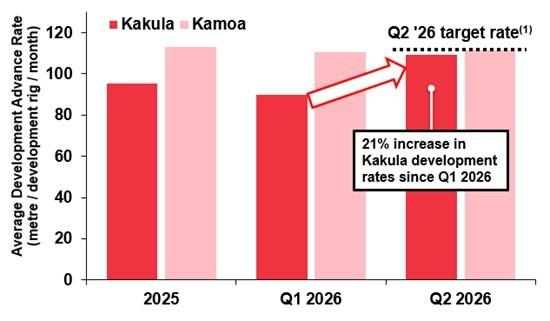
Figure 2. Chart of underground development rates at Kamoa and Kakula against the new quarterly target introduced in late Q1 2026 (average linear meters of development advance per development drill rig per month).
(1) Q2 2026 target is based on the updated development rates as outlined in the Kamoa-Kakula MRE, dated March 31, 2026
On-site, 500,000 tonnes-per-annum copper smelter remains at 60% of design capacity; acid sales continue to benefit from global supply chain disruptions
The smelter is targeting production of approximately 850 tonnes per day of copper in anode in H2 2026, equivalent to an annualized rate of 300,000 tonnes of copper, or approximately 60% of design capacity. Further ramp-up of the smelter, beyond 60% capacity, is currently constrained by concentrate feed. The smelter is expected to ramp up to its full capacity of 500,000 tonnes per annum in 2028.
In addition to copper anodes, the smelter is producing high-strength sulphuric acid at an average rate of 1,250 tonnes per day, equivalent to approximately 450,000 tonnes per annum, compared with the steady-state design capacity of 700,000 tonnes per annum. The sulphuric acid is sold to nearby mining operations on the DRC Copperbelt. The offtakers purchase the sulphuric acid from Kamoa-Kakula’s mine gate. The realized price for high-strength sulphuric acid sales in July is set to be a record of approximately $840 per tonne. During the quarter, 112,307 tonnes of high-strength sulphuric acid were produced. At the end of the quarter, approximately 11,300 tonnes of acid were held in inventory and stored on-site.
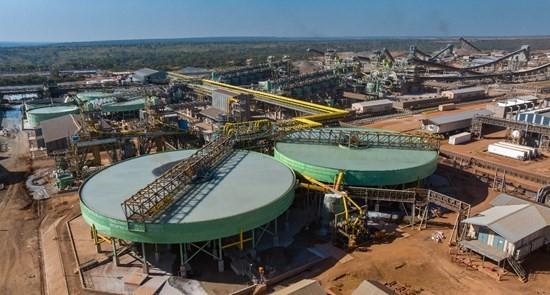
View over the Project 95 construction works (foreground). Commissioning of Project 95 was completed in June, with recoveries from the Phase 1 and 2 concentrators (background) set to increase from Q3 2026.
Kamoa-Kakula’s on-site solar facility with battery storage set to ramp up to full capacity during Q3 2026; plans well advanced to double on-site solar capacity to 120 MW by the end of 2027, lowering cash costs
Commissioning of Kamoa-Kakula’s on-site solar photovoltaic (PV) facilities is underway. Once fully ramped up during the third quarter, the facilities will deliver 60 megawatts (MW) of continuous baseload power to Kamoa Copper as its sole offtaker.
The two facilities are owned, operated, and funded by CrossBoundary Energy and Green World Energie. The two facilities have a combined 433 MW of peak installed solar photovoltaic (PV) capacity and 1,107 megawatt-hours (MWh) of battery energy storage system (BESS) capacity. The facility is the largest hybrid solar PV and BESS facility installed by a mining company in Africa.
Kamoa-Kakula is advancing plans to double the on-site solar power capacity, with battery storage, up to 120 MW by the end of 2027. In the second quarter, a tender was awarded, and a power purchase agreement (PPA) was signed with Green World Energie for an additional 30 MW on-site hybrid solar PV facility with BESS. Construction is expected to be completed in Q3 2027. A further 30 MW solar PV facility is currently undergoing final contract negotiation and is expected to be awarded soon.
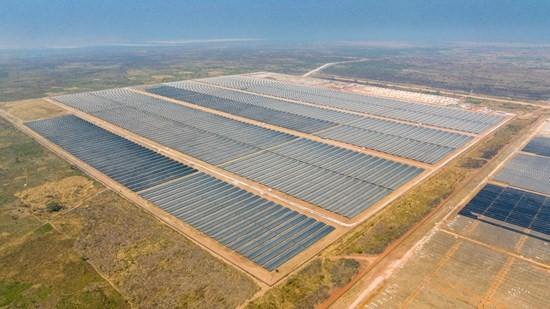
Once fully ramped up, the new on-site solar facility will deliver 60 MW of continuous baseload power to Kamoa-Kakula’s operations. The facility is the largest hybrid solar PV and battery storage facility installed by a mining company on the African continent.
Kipushi concentrator produced a record 70,177 tonnes of zinc in Q2 2026, a quarter-on-quarter increase of 8%; production tracking towards the upper end of 2026 guidance
Summary of quarterly production data from Kipushi
| Kipushi Concentrator | Q2 2025 | Q3 2025 | Q4 2025 | Q1 2026 | Q2 2026 |
| Ore milled (tonnes) | 153,342 | 168,862 | 194,140 | 196,774 | 200,774 |
| Feed grade of ore milled (% zinc) | 33.37 | 37.81 | 36.18 | 36.96 | 38.71 |
| Zinc recovery (%) | 85.22 | 89.36 | 87.71 | 90.63 | 91.91 |
| Zinc in concentrate produced (tonnes) | 41,788 | 52,700 | 61,444 | 65,044 | 70,177 |
Data in bold denotes a quarterly record.
The Kipushi concentrator produced a record 70,177 tonnes of zinc in concentrate in Q2 2026, up 8% quarter-on-quarter and equivalent to an annualized zinc production of approximately 280,000 tonnes. The quarterly performance was boosted by a record 200,774 tonnes of ore milled, a record feed grade of 38.7% zinc and a record concentrator recovery of 92%. In addition, a record 25,677 tonnes of zinc were produced in May.
Kipushi’s Q2 2026 production marks the seventh consecutive quarter-on-quarter increase in zinc production, as shown in Figure 3, with operations on track to meet the 2026 production guidance of 240,000 to 290,000 tonnes of zinc in concentrate.
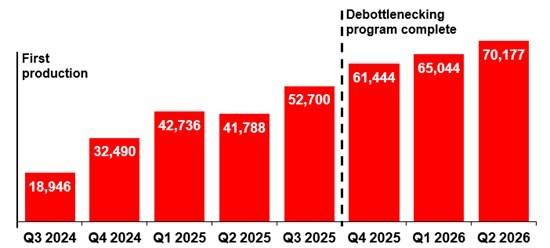
Figure 3. Quarterly zinc in concentrate produced by the Kipushi concentrator (tonnes). Q2 2026 production annualized is equivalent to 280,000 tonnes of zinc in concentrate
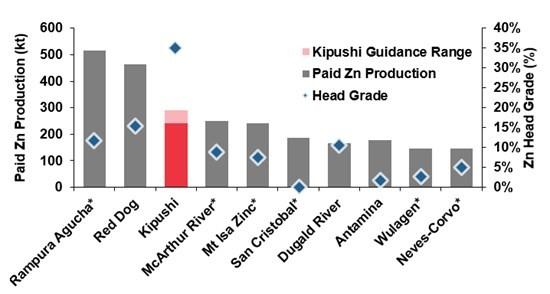
Figure 4. World’s top 10 zinc mines by contained zinc production (‘000 tonnes), with head grade (% zinc). Kipushi is on track to meet 2026 production guidance, placing it among the top 3 zinc mining operations.
Notes. Source: Company Data, S&P Capital IQ.
*Denotes that company guidance not provided, in its place 2025 paid zinc production used as per S&P Capital IQ, 2026. Lanping Jinding excluded. Production for Kipushi is the 2026 guidance range as disclosed on January 14, 2026
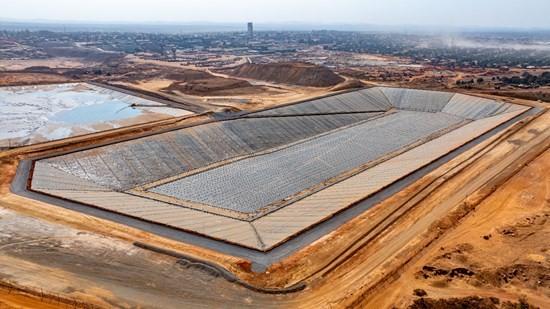
Aerial view over Kipushi’s newly expanded tailings storage facility, which is compliant with the Global Industry Standard on Tailings Management (GISTM). The Kipushi Mine has the smallest tailings storage facility of any major base metal mine globally.
Commissioning of Platreef Mine’s Shaft #3 increases hoisting capacity by fivefold to support ramp-up of Phase 1 concentrator
Summary of quarterly production data from Platreef Phase 1 commissioning
| Platreef Phase 1 Concentrator | Q4 2025 | Q1 2026 | Q2 2026 |
| Ore milled (tonnes) | 25,543 | 27,512 | 37,296 |
| Feed grade of ore milled (3PE + AU g/t) | 2.64 | 2.78 | 2.19 |
| Recovery (%) | 45 | 57 | 59 |
| PGM production (3PE + Au oz) | 965 | 1,428 | 1,538 |
Production from the 0.8-Mtpa Phase 1 concentrator started on November 18, 2025. Since then, approximately 3,931 ounces of platinum, palladium, rhodium, and gold have been produced. Phase 1 operations have not yet reached commercial production. Therefore, production rates achieved to date are not representative of steady-state conditions.
Platreef Mine’s Phase 1 concentrator continued to be campaigned, or batch operated, during the quarter, predominantly fed by lower-grade development ore. Commercial production is now expected in Q4 2026, when identified bottlenecks in materials handling and the processing plant are expected to be resolved.
Construction of Shaft #3 was completed on schedule in late Q1 2026, with the first ore hoisted to the surface on April 1, 2026. Commissioning of the shaft was finalized in June. Commissioning of the underground infrastructure supporting Shaft #3, consisting of a crusher, two conveyor belts and two strike tips, was also completed in June 2026.
Following the commissioning of Shaft #3 and its associated underground infrastructure, the total hoisting capacity at the Platreef Mine has increased by approximately fivefold. The new shaft also enables the concurrent hoisting of stoping ore and development waste, which was previously not possible with Shaft #1.
Following the increase in hoisting capacity, stoping (production mining) of the higher-grade ore within the Flatreef orebody commenced at the end of the second quarter. The mining of two stopes has been completed so far. Mining rates are expected to ramp up throughout H2 2026.
Shaft #3 is now also hoisting development waste, as the underground infrastructure is constructed in preparation for the Phase 2 expansion, which is expected to be completed by the end of 2027.
Construction works on Phase 2 expansion advancing; first pour of Phase 2 concentrator concrete foundations expected later this month
Earthworks on the Phase 2 expansion’s 3.3-million-tonne-per-annum concentrator began at the start of the second quarter and are advancing according to plan. The first pour of the concentrator’s concrete foundations is expected later this month. Engineering work on the concentrator is advancing, with the current focus on completing the civil and steel designs. The procurement of mechanical and electrical secondary long-lead items is underway, as well as the ordering of the Electrical, Control, and Instrumentation (EC&I) packages. The Structural, Mechanical, Piping, and Platework (SMPP) installation package for the flotation plant was awarded during the second quarter.
The widening of Shaft #2 from its current diameter of 3.1 metres to 10 metres commenced at the start of the second quarter. The work consists of a mining technique called slipe-and-line that widens the shaft from the top down, while simultaneously installing a permanent shaft-wall lining. Shaft #2 is expected to be ready to hoist labour and materials by the end of 2028 and ready to hoist ore by the end of 2029, supporting both the steady-state operations of Phase 2, as well as the future Phase 3 expansion.
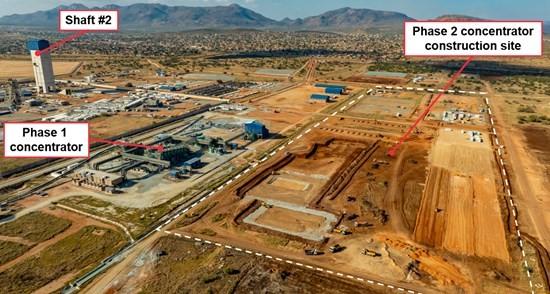
View over the construction site of the Platreef Mine’s Phase 2 concentrator, adjacent to the Phase 1 concentrator and existing surface infrastructure.
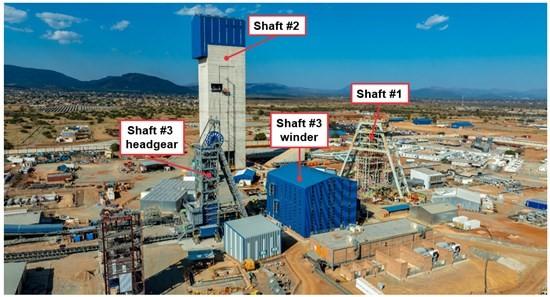
View over the headgear of Platreef Mine’s three shafts. The recently commissioned 4-Mtpa Shaft #3 will be used to hoist ore for the Phase 1 operation as well as, from Q4 2027, for the Phase 2 operations. Shaft #2 is currently being widened to a diameter of 10 metres, making it the largest shaft in Africa.
Ivanhoe Mines to issue Q2 2026 financial results after market close on July 29, and host conference call for investors on July 30, 2026
Ivanhoe Mines will report its Q2 2026 financial results and a detailed update on its operations after market close on Wednesday, July 29, 2026.
After issuance, the Financial Statements and Management’s Discussion and Analysis will be available at www.ivanhoemines.com and www.sedarplus.ca.
Qualified Persons
Disclosures of a scientific or technical nature disclosed in this press release have been reviewed and approved by Simon Bottoms, who is considered, by virtue of his education, experience, and professional association, a Qualified Person under the terms of NI 43-101. Mr. Bottoms is not considered independent under NI 43-101 as he is Ivanhoe Mines’ Executive Vice President, Technical Services. Mr. Bottoms has verified the technical data disclosed in this press release.
Ivanhoe has prepared independent, NI 43-101-compliant technical reports for the Kamoa-Kakula Copper Complex, the Kipushi Mine and the Platreef Mine, each of which is available on the company’s website and under the company’s SEDAR+ profile at www.sedarplus.ca
These technical reports include relevant information regarding the effective dates and the assumptions, parameters, and methods of the mineral resource estimates on the Kamoa-Kakula Copper Complex, the Kipushi Mine and the Platreef Mine cited in this press release, as well as information regarding data verification, exploration procedures, and other matters relevant to the scientific and technical disclosure contained in this press release in respect of the Kamoa-Kakula Copper Complex, Kipushi Mine and the Platreef Mine.
About Ivanhoe Mines
Ivanhoe Mines is a Canadian mining company focused on advancing its three principal projects in Southern Africa: the expansion of the Kamoa-Kakula Copper Complex in the DRC, the ramp-up of the ultra-high-grade Kipushi zinc-copper-germanium-silver mine, also in the DRC; and the phased development of the tier-one Platreef platinum-palladium-nickel-gold-rhodium-copper mine in South Africa.
Ivanhoe Mines is also exploring its highly prospective, 54-100% owned exploration licences in the Western Forelands, covering an area over five times larger than the adjacent Kamoa-Kakula Copper Complex. Ivanhoe is exploring for new sedimentary copper discoveries, as well as expanding and further defining its high-grade Makoko, Kiala, and Kitoko copper discoveries as the company’s next major development projects.
Brutus Mining Inc. (CSE: BRU) (FSE: ZI3) is pleased to announce that it has closed its non-brokered ... READ MORE
Jaguar Uranium Corp. (NYSE American: JAGU) is pleased to announce an independent Mineral Resource E... READ MORE
Auro Metals Inc. (TSX-V: AURO) (OTCQB: AURFF), is pleased to announce the assay results of the fina... READ MORE
Endeavour Silver Corp. (NYSE: EXK) (TSX: EDR) is pleased to announce that repairs to the primary bal... READ MORE
Scorpio Gold Corp. (NASDAQ: SGLD) (TSX-V: SGLD) (OTCQB: SRCRF) (FSE: RY9) is pleased to announce re... READ MORE