







West Point Gold Corp. (TSX-V: WPG) (OTCQX: WPGCF) (FSE: LRA0) is pleased to announce the results from hole GC26-148, drilled below the high-grade Northeast Tyro Zone at its flagship Gold Chain Project in Arizona, which intersected 66.2 metres of 6.57 grams per tonne gold from 219m, including 20.7m of 18.25 g/t Au.This step-out core hole successfully extended the NE Tyro Zone’s high-grade mineralization to more than 250m below surface. The zone remains open at depth and along strike. Results reported herein comprise 318.8m of the recently completed 21,079m drill program. Results from 21 holes representing 6,550m are still pending and will be incorporated into the Company’s upcoming Maiden Resource Estimate later in 2026.
Highlights:
“This drill hole indicates that the high grades at NE Tyro continue to depth and this zone will remain open following the upcoming maiden resource. There are assays pending from additional holes at this depth from both NE Tyro and the Tyro Main Zone. This result, coupled with those that are pending, suggests that deeper drilling at Tyro will resume with the funded Fall 2026 to Spring 2027 drill program,” stated Derek Macpherson, President and CEO.
Table 1: Drill Results
| Holes | From (m) | To (m) | Width (m) | Grade (g/t Au) |
| GC26-148 | 219.0 | 285.2 | 66.2 | 6.57 |
| Including | 249.2 | 269.9 | 20.7 | 18.25 |
| Note: All widths shown are downhole; true widths are approximately 55% of downhole widths. | ||||
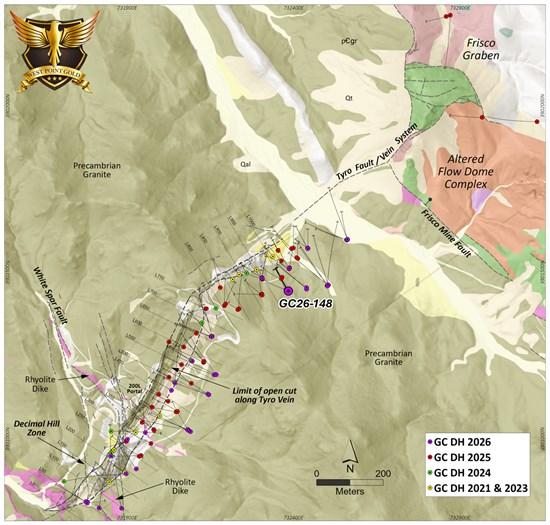
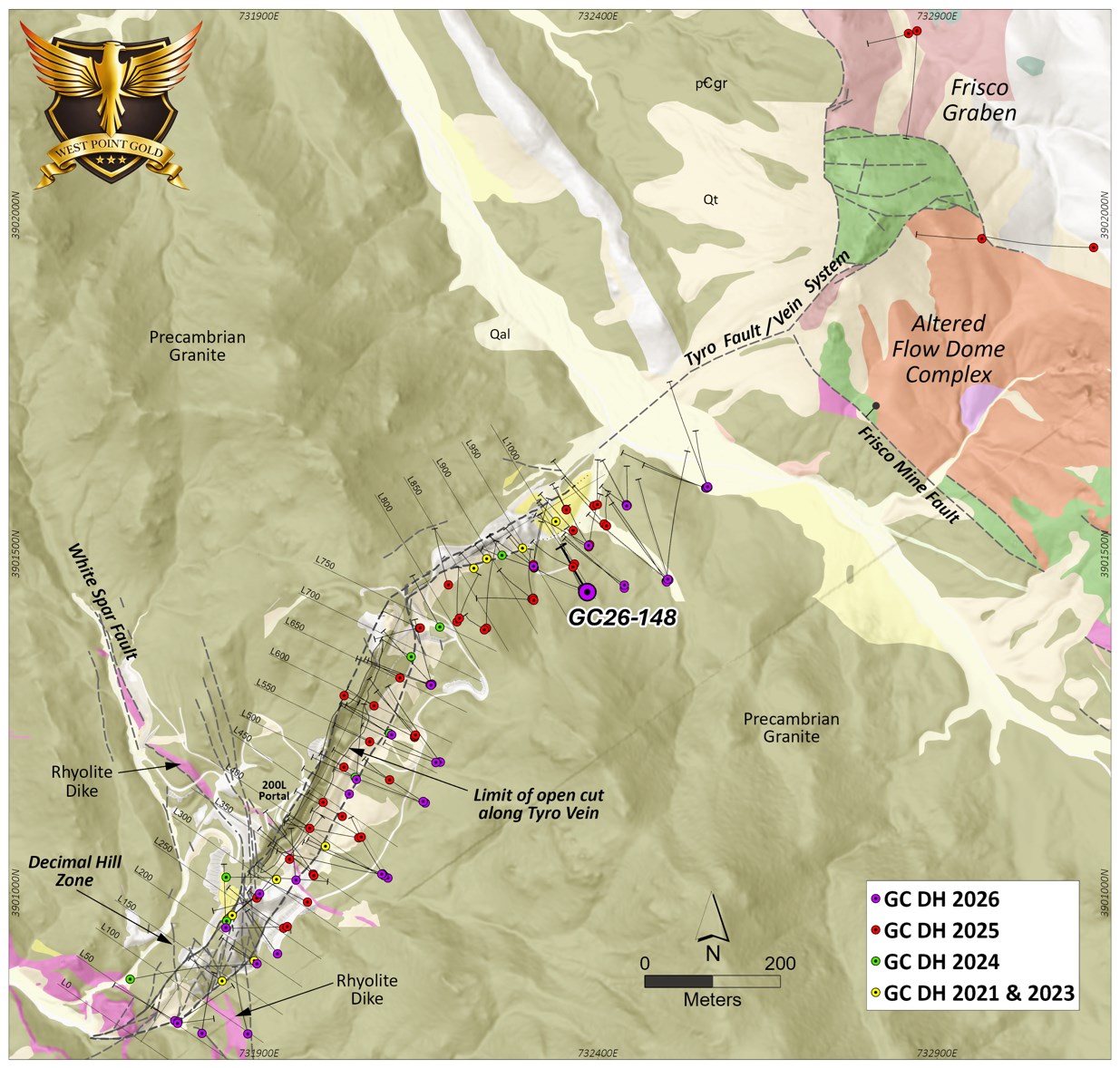
Figure 1: Plan view of the main Tyro vein showing geology and drilling conducted in 2021, 2023, 2024, 2025, and 2026. Note the location of Hole No. GC26-148.
To view an enhanced version of this graphic, please visit:
https://images.newsfilecorp.com/files/5717/302484_5956566a3431698d_002full.jpg
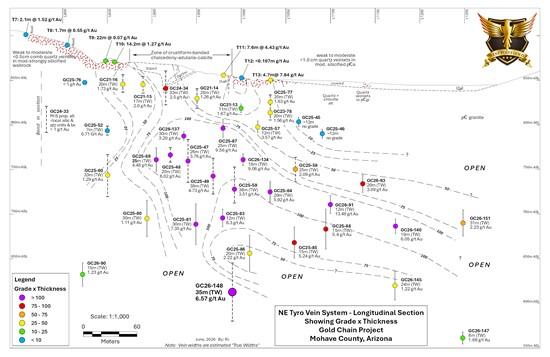
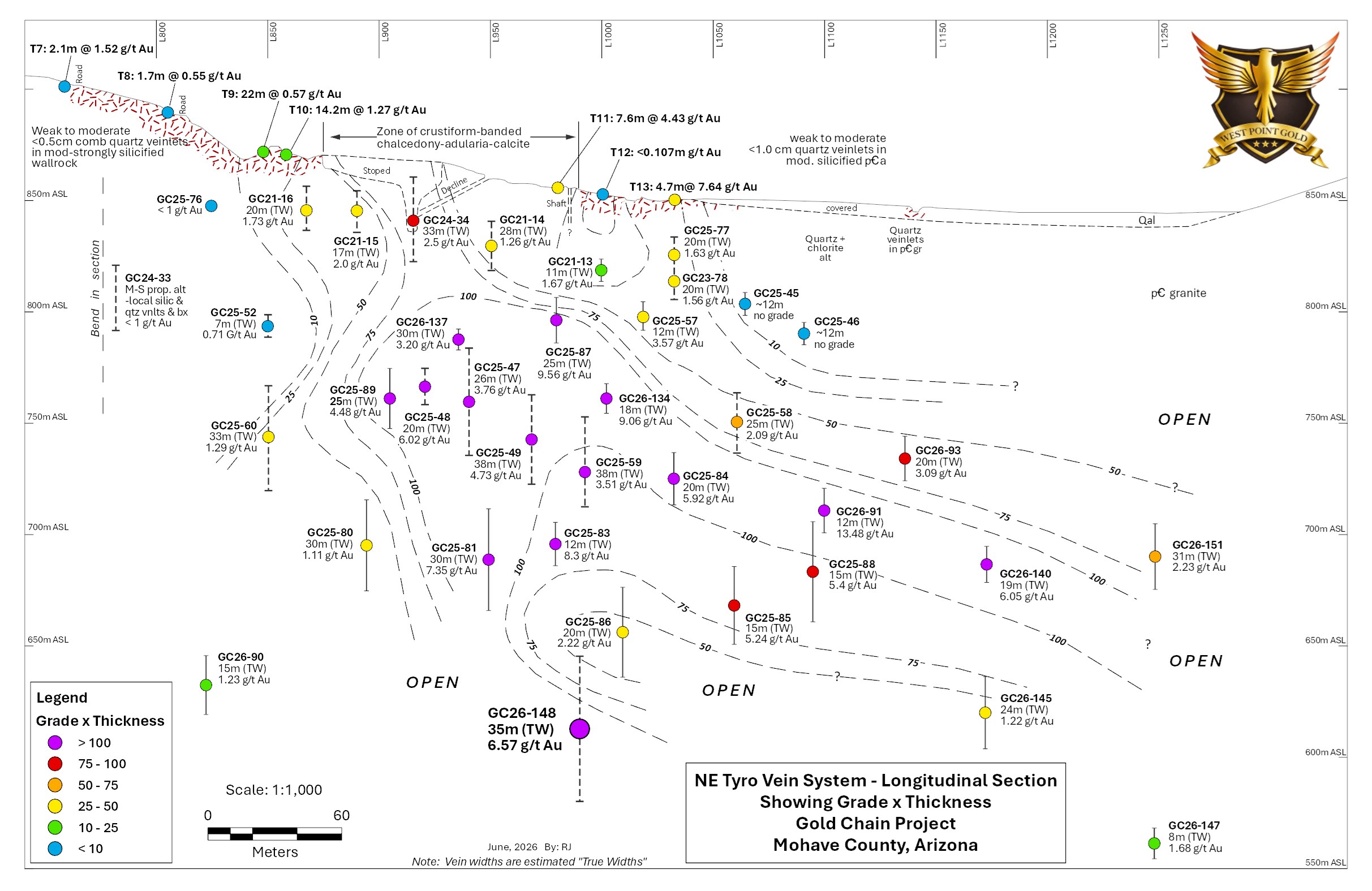
Figure 2. Longitudinal perspective of the Tyro NE zone contoured Grade Thickness (g/t Au X estimated true thickness).
To view an enhanced version of this graphic, please visit:
https://images.newsfilecorp.com/files/5717/302484_5956566a3431698d_003full.jpg
Summary
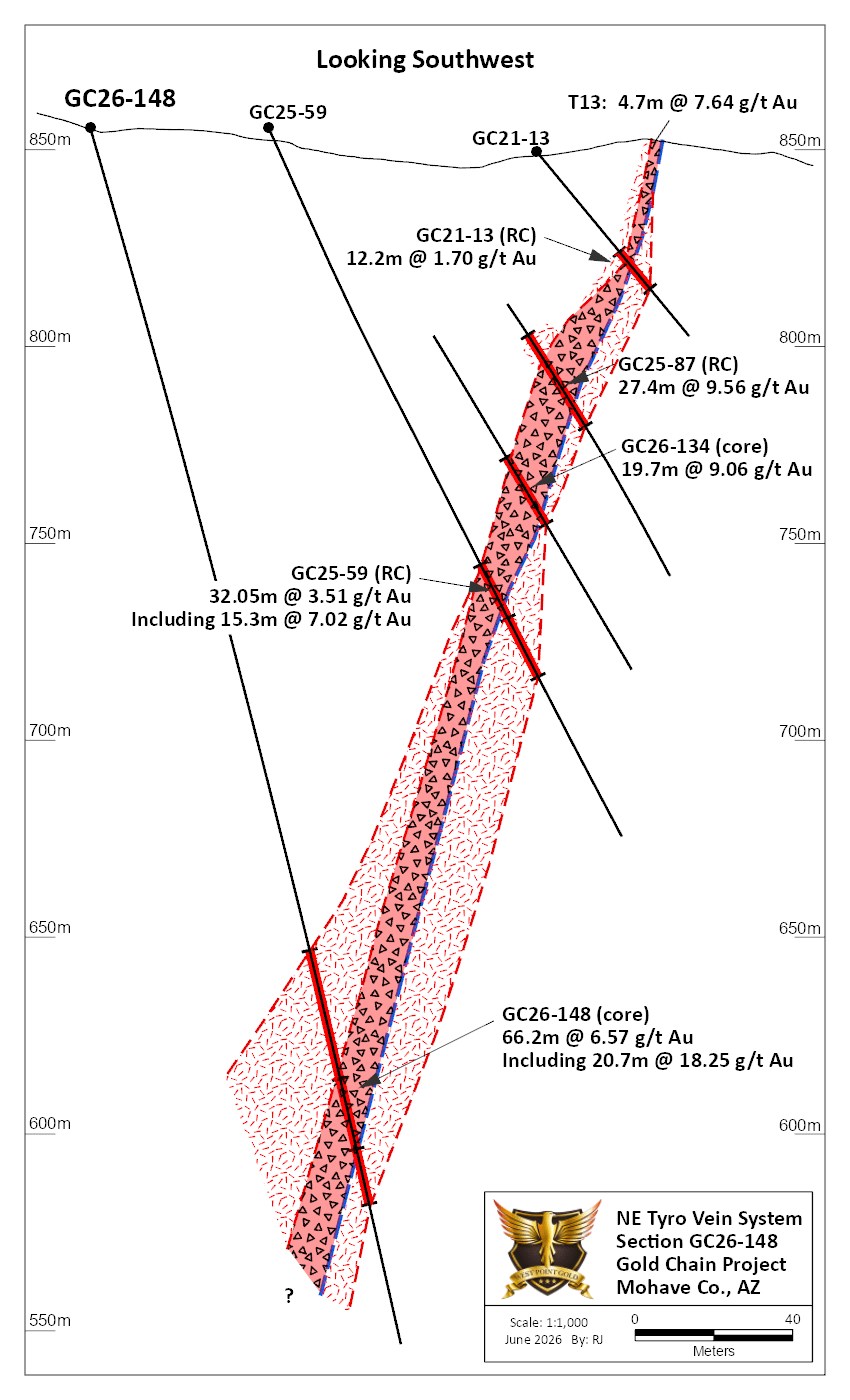
Hole GC26-148 was targeted to test below previous drilling at about 250m below the surface (Figure 2). Figure 3 reveals a broad zone of quartz-calcite-adularia (?) veinlets, stockwork and vein breccia over 66.2m between 219m and 285.2m containing 6.57 g/t Au. In context with the surrounding holes, a dip of 73 degrees is suggested, resulting in an estimated true width of about 35m. The location of this relatively deep intercept is shown in Figure 2 and appears to be an extension of a steeply plunging shoot.
Figure 3 also reveals that the NE Tyro vein is a robust, uniform vein system that dips to the SE at 70o to 75o and ranges in width from 10m to 35m. The width of the mineralized package varies relative to the development of quartz veinlets and stockwork in the hanging wall and ‘outboard’ from the principal quartz vein/breccia at the footwall. Precambrian granite, along with lenses or ‘xenoliths’ of gneiss, schist and amphibolite, are the host rocks.
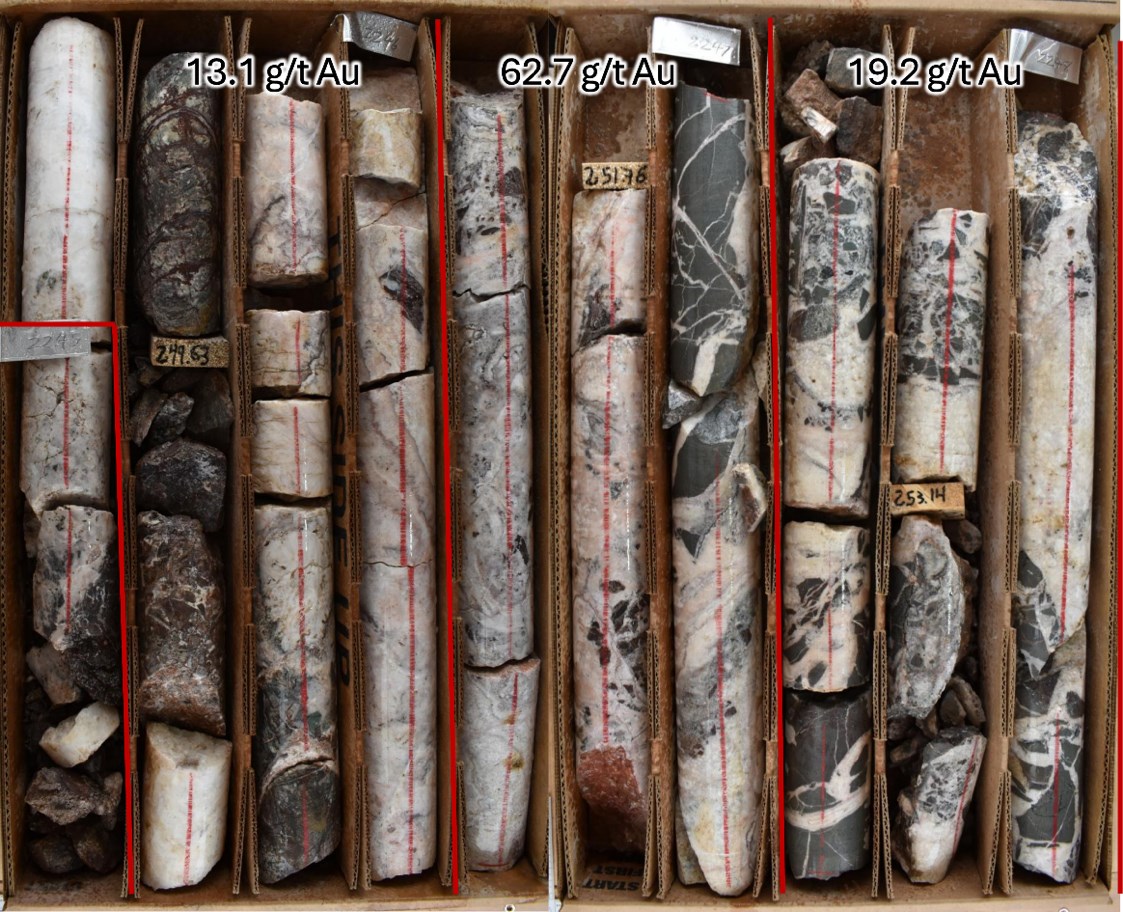
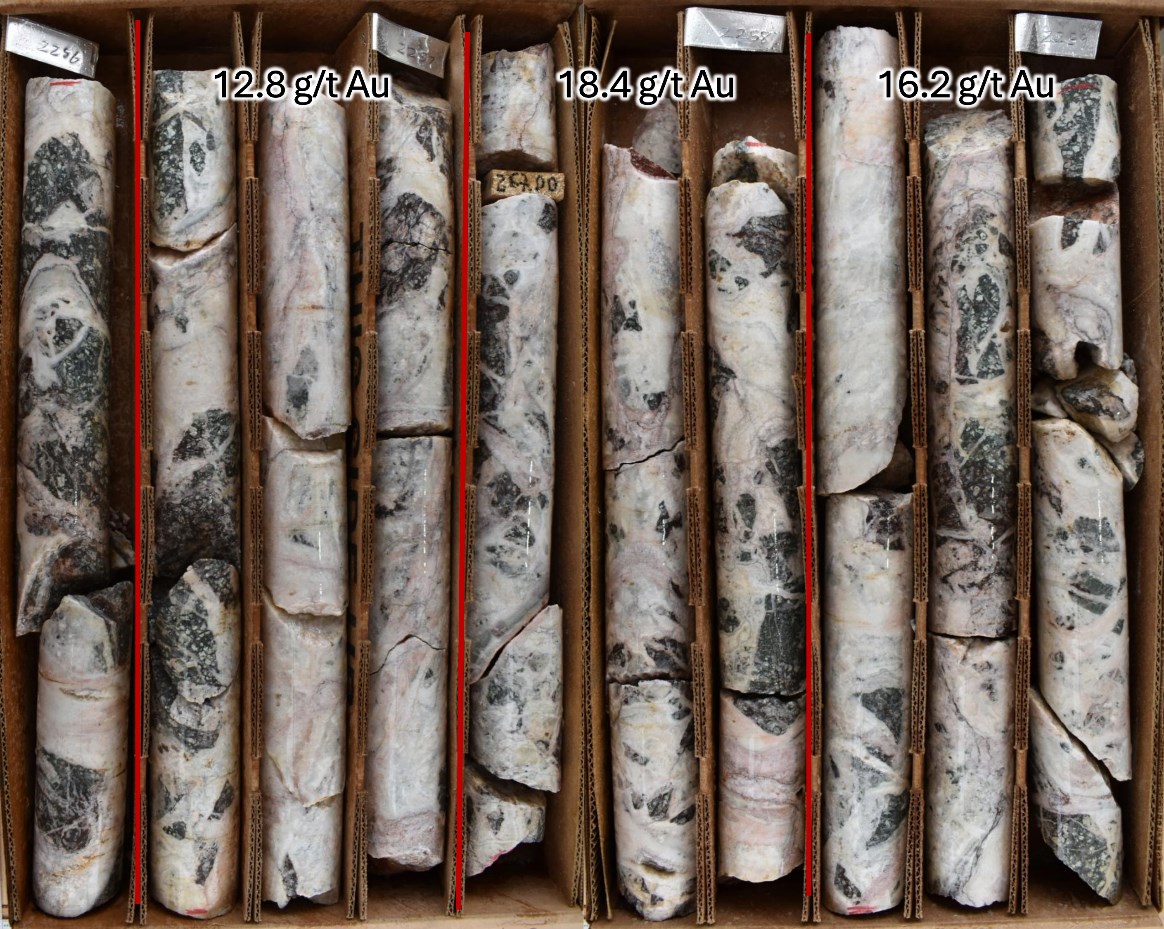
The main mineralized zone (Figure 3) appears to be a zone of strong fracturing and brecciation cemented by a few to several crustiform-banded stages composed of quartz-calcite-adularia (Figures 4 and 5). These figures provide a closer view of the high-grade zone (20.7m at 18.25 g/t Au). All samples consist of a high percentage of vein, veinlets, and breccia composed mostly of quartz deposited in several events, revealing a variety of textures. Some of the most pronounced crustiform banding can be seen in Figure 4, where Sample No. 2246 contains 1.73m at 62.7 g/t Au.
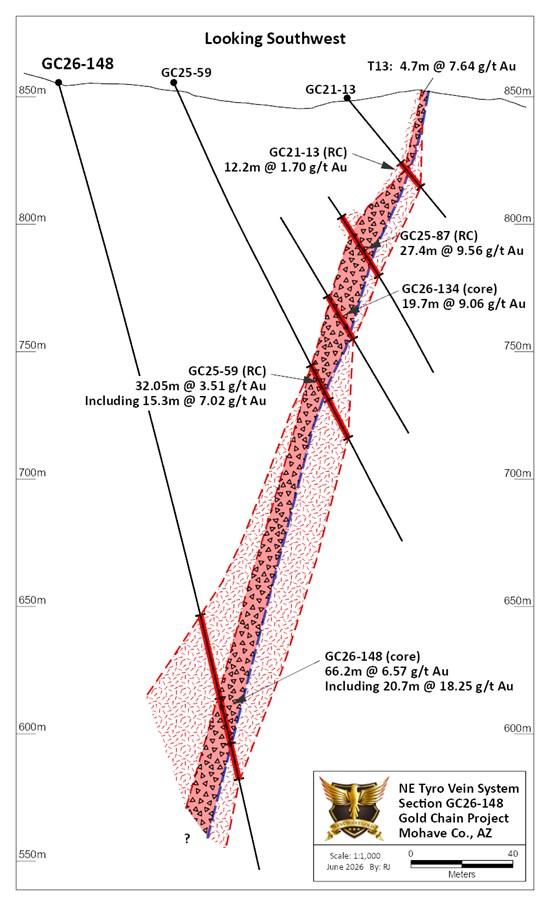
Figure 3. Geologic section drawn along GC26-148 showing vein and spatial relation to GC21-013, GC25-087, -059, GC26-134 and the surface (Trench 13).
To view an enhanced version of this graphic, please visit:
https://images.newsfilecorp.com/files/5717/302484_5956566a3431698d_004full.jpg
Overall, quartz >> calcite veinlets in propylitized (chlorite + quartz + pyrite) and illitized (quartz + illite + pyrite) Precambrian rocks (granite and amphibolite) define the distal zone of veining (Figure 3) and increase with depth from a few percent to 50% with variable, but generally low gold values (<1.68 g/t Au; Figure 3). The main mineralized zone (249.2m to 269.9m) commences with moderate to strong quartz-calcite-adularia (?) veinlets, stockwork and breccia, giving way to a multi-stage breccia zone up to the FW contact (Figures 3 – 5). Unlike other holes along this section (Figure 3), Hole GC26-148 encountered several metres of vein/hydrothermal breccia and possibly phreatic breccia (fluidal textures) in the footwall and possibly below the controlling structure. Figure 3 indicates that the breccia and surrounding damage zone is wide and may remain so to greater depths. The modelling of these features in the upcoming weeks will provide greater insight into deeper targets.
Breccia textures are prevalent in these holes and were developed during multiple events. Some breccia masses are ‘jigsaw’ in character, suggesting little or no fragment transport. Other breccias are fine-grained, heterolithic, and reveal fluidal or ‘streaming’ textures that suggest considerable transport (and energy). The dominance of breccias at the footwall portion of the vein complex suggests both recurrent movement and explosive events likely related to deeper fluid boiling and potential gold deposition.
Bladed calcite or “lattice texture” has developed in several stages and ranges from delicate bands within crustiform/colloform-banded chalcedony to coarse, angular fragments in late-stage breccia. Native gold has been observed within minute dendritic growths of a black opaque, perhaps electrum or a sulfosalt. Documenting these features may prove important as the Company evaluates events related to gold deposition at greater depths.
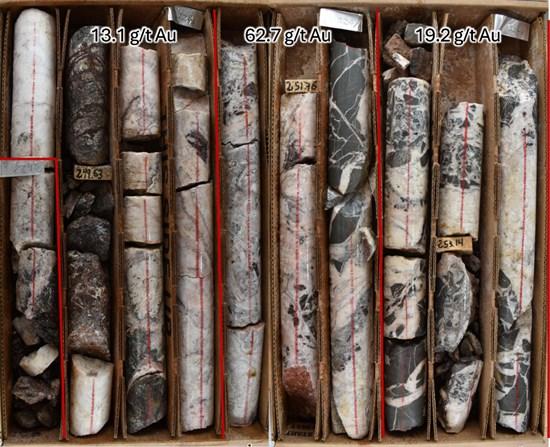
Figure 4. Photo GC26-148 showing a portion of the vein and corresponding gold values; samples include Nos. 2245 – 2247. Core reveals that the NE Tyro vein is a broad zone of multi-stage veins and breccia revealing an array of textures.
To view an enhanced version of this graphic, please visit:
https://images.newsfilecorp.com/files/5717/302484_5956566a3431698d_005full.jpg
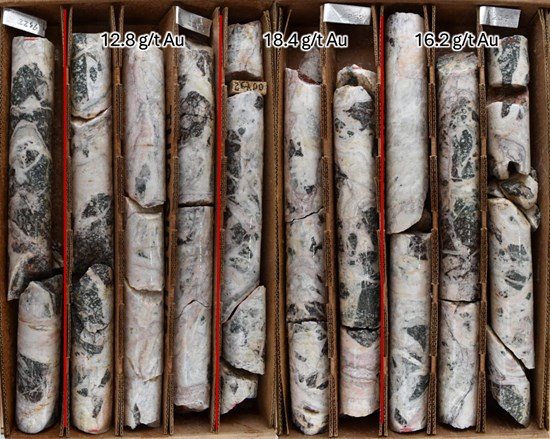
Figure 5. Photo GC26-148 showing a portion of the vein and corresponding gold values; samples include 2256 – 2258.
To view an enhanced version of this graphic, please visit:
https://images.newsfilecorp.com/files/5717/302484_5956566a3431698d_006full.jpg
Table 2: Drill hole locations and descriptions
| Hole No. | Azimuth (degrees) | Inclination (degrees) | Easting | Northing | Length (m) |
| GC26-148 | 325 | -75 | 732,384 | 3,901,443 | 318.8 |
Qualified Person
Robert Johansing, M.Sc. Econ. Geol., P. Geo., the Company’s Vice President, Exploration, is a qualified person as defined by NI 43-101 and has reviewed and approved the technical content of this press release. Mr. Johansing has also been responsible for overseeing all phases of the drilling program, including logging, cutting, labelling, bagging and transport from the project to American Assay Laboratories of Sparks, Nevada. Reverse Circulation drill holes have a diameter of about 10cm, and samples have an approximate weight of 5 to 10kg. Core size is HQ (63.5mm) and is logged, photographed and cut at WPG’s Bullhead City sampling facility including the insertion of blanks and standards. All samples are packaged for shipment at the facility and trucked to AAL in Reno. Samples were then dried, crushed and split, and pulp samples were prepared for analysis. Gold was determined by fire assay with an ICP finish, and over-limit samples were determined by fire assay and gravimetric finish. Silver plus 15 other elements were determined by Aqua Regia ICP-AES (IM-2A16), and over-limit samples were determined by fire assay and gravimetric finish. Both certified standards and blanks were inserted on site along with duplicates, standards and blanks inserted by American Assay. The results summarized above have been carefully reviewed with reference to the QA/QC results. Standard sample chain of custody procedures were employed during drilling and sampling campaigns until delivery to the analytical facility.
About West Point Gold Corp.
West Point Gold is an exploration and development company focused on unlocking value across four strategically located projects along the prolific Walker Lane Trend in Nevada and Arizona, USA, providing shareholders with exposure to multiple discovery opportunities across one of North America’s most productive gold regions. The Company’s near-term priority is advancing its flagship Gold Chain Project in Arizona.
For further information regarding this press release, please contact:
Aaron Paterson, Corporate Communications Manager
Phone: +1 (778) 358-6173
Email: info@westpointgold.com
Stay Connected with Us:
LinkedIn: linkedin.com/company/west-point-gold
X (Twitter): @westpointgoldUS
Facebook: facebook.com/Westpointgold/
Website: westpointgold.com/
Scandium Canada Ltd. (TSX-V: SCD) is pleased to announce additional assay results from the 2... READ MORE
Search Minerals Inc. (TSX-V: SMY) (OTC Pink: SHCMF) is pleased to announce that it has closed the th... READ MORE
Golden Spike Resources Corp. (CSE: GLDS) (OTCQB: GSPRF) (FSE: L5Y) is pleased to announce the... READ MORE
GoldHaven Resources Corp. (CSE: GOH) (OTCQB: GHVNF) (FSE: 4QS) is pleased to announce that it has cl... READ MORE
Independence Gold Corp. (TSX-V: IGO) (OTCQB: IEGCF) (FSE: 625) is pleased to announce assay r... READ MORE