






Arras Minerals Corp. (TSX-V: ARK) (OTCQB: ARRKF) is pleased to report drill results from the Berezski North Target, Elemes Project, Northeast Kazakhstan.
Highlights include:
EL26032
EL26033
These holes were designed to explore the shallow breccias and determine the extents of the underlying porphyry mineralization discovered in drill-hole EL24005 and expanded by hole EL25027. To date, 8 holes have been completed at the Berezski North target since drilling recommenced in Q1, 2026, and the results from these two holes confirm the presence of a preserved, large, well-developed porphyry system that is open in multiple directions and to depths exceeding 900m. In addition, these holes have extended the strike length of the high-grade breccias to be in excess of 600m.
Tim Barry, CEO of Arras Minerals, commented, “These latest results from Berezski North represent a step-change for the Company. Intersecting more than 900 metres of porphyry-style mineralization from surface is a very significant result that has materially advanced our understanding of the scale and potential of this target. This drilling also confirmed the near-surface, high-grade breccias, and has extended their strike length to now over 600 metres. Importantly the system remains open in multiple directions and at depth. These drill results combined with the coincident 3 km x 2 km geophysical and geochemical footprint we observe in the data, suggests there is still significant potential to be unlocked at the Berezski North Target. An additional six holes have been drilled with assays pending, and once these results are received and interpreted, we expect to bring the drills back to Berezski North to follow up on additional targets.”
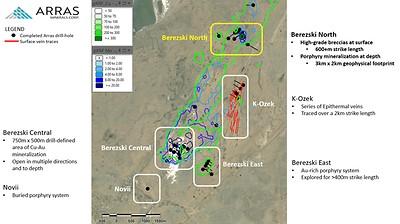
Mr. Barry went on to say, “Looking at the bigger picture along the entire 8.8-kilometer Berezski Trend, it is important to note that the Berezski North target sits more than 5 km north of both the “Berezski East target”, where we recently announced 115.7 m grading 1.44 g/t Au and 0.24% Cu, and the “Berezski Central Target”, where we previously announced 261 m grading 0.64% CuEq from surface. At the K-Ozek target that runs along the eastern margin of the Berezski Trend, a series of quartz veins are exposed over a 2 km strike length by historic Soviet trenching. Previously reported sampling returned 27 grab samples grading greater than 5 g/t Au. Over the past month, drilling has tested portions of the K-Ozek area, with three holes completed and one underway with assays pending. The drilling has intersected a series of quartz-sulphide veins surrounded by a wide zone of stockwork sulphide veining. Arras currently has four diamond drill rigs on site focused on the Berezski Trend as part of its ongoing 20,000 m drill program this year.”
Drilling Summary:
Berezski North consists of two interrelated mineralized zones, a near-surface, high-grade breccia zone, underlain by a large porphyry system. The breccia zone has been defined over more than a 600m strike length and remains open to the NW and SE. It consists of sulphide and quartz-tourmaline cemented andesite breccias with patchy and disseminated pyrite and chalcopyrite, tetrahedrite and minor enargite.
The underlying porphyry occurs in potassic altered diorites and mineralization is found as zones of intense sheeted veining with localized brecciation, and disseminations. Primary copper minerals are chalcopyrite with minor bornite. Drilling has outlined porphyry mineralization to depths more than 900m and is open laterally and to depth.
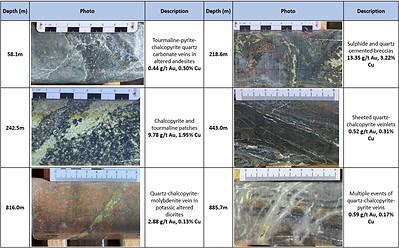
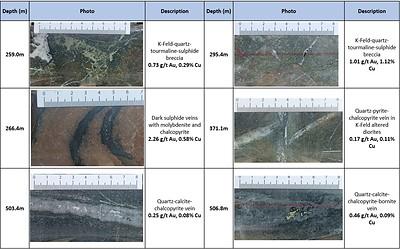
EL26032 was drilled to explore the near surface breccias and the underlying porphyry mineralization intersected by holes EL24005 and EL25027. The hole was collared in phyllic and propylitic altered and mineralized diorite breccias to 70m, where the hole intersected a fault zone and passed into weakly altered diorites. At 162.1m the hole intersected mineralized diorite breccias with patches of k-feldspar and tourmaline to a depth of 285.9m. At 380.8m it intersected strongly potassic altered diorites with pervasive silicification and with sheeted quartz-pyrite-chalcopyrite veins, with molybdenite and minor bornite, that continued to the end of the hole at 935.9m depth.
EL26033 is located approximately 200m to the west of hole EL26032, it was designed to follow-up on the high-grade mineralization intersected in hole EL25014A. The hole drilled a sequence of generally fine- to medium-grained andesites, with propylitic alteration, that is progressively overprinted by potassic alteration at depth. At 259m depth the hole intersected a zone of brecciated andesites that were strongly mineralized and altered, before returning to andesites at 315m. At 505m depth the hole intersected mineralized diorites to the end of the hole at 630.2m depth.
Mineralization starts at approximately 100m depth with disseminated pyrite and minor chalcopyrite in veinlets, and filling fractures. At 259m depth a zone of strongly mineralized tourmaline breccias was intersected at 259m depth and is characterized by K-feldspar-quartz-tourmaline alteration with blebs, clots, veinlets, and disseminated chalcopyrite and pyrite. From 505m depth to the end of the hole, it intersected distal porphyry style mineralization consisting of disseminated pyrite, with chalcopyrite and minor bornite found in quartz-sulphide B-type veins and sulphide veinlets hosted in diorites.
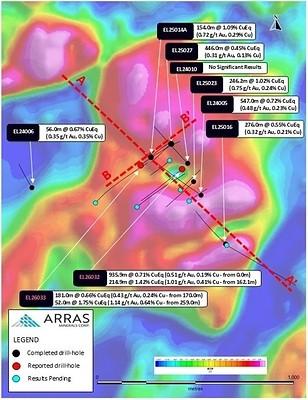
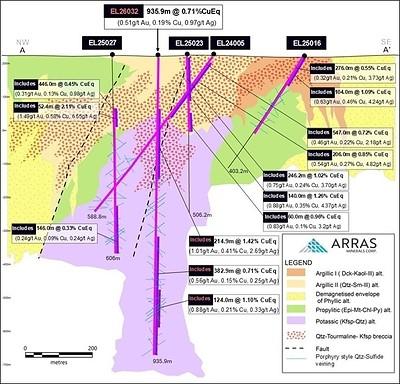
Results from this news release include:
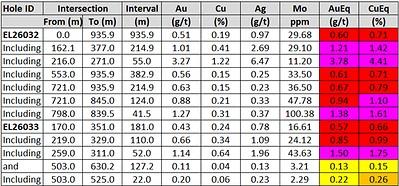
Notes: For copper and gold equivalent calculations the following metal process were used: US$3.75/lb. Copper, US$3,000/oz Gold, US$35/oz Silver, US$30/lb Molybdenum, and metallurgical recoveries have been updated to Cu 90%, Au 85%, Ag 75%, Mo 80%. All intervals are presented as core lengths as the true thicknesses of mineralization is currently unknown.
Table 2. Drill-hole locations
| Hole_ID | Coordinates (UTM) | |||||
| Easting | Northing | RL | Azimuth | Dip | Hole Depth (m) | |
| EL26032 | 508274 | 5717493 | 229 | 230 | -80 | 935.9 |
| EL26033 | 508063 | 5717512 | 229 | 050 | -70 | 630.2 |
Berezski North Porphyry System
The Company believes that there is a large, preserved porphyry system at Berezski North. Work conducted to date has provided three distinct datasets that support this theory:
Induced Polarization Survey
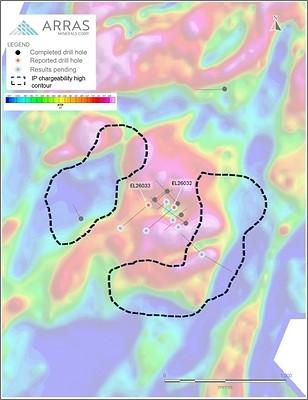
The Induced polarization (IP) survey conducted in 2024 highlighted a prominent 2km x 2km chargeability high anomaly surrounding the current drilling area. The anomaly begins at surface and shows a strong increase in intensity at approximately 100m below surface, reaching values greater than 12 mV/V.
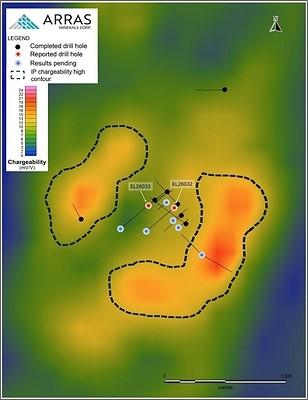
The Company strongly believes that this broad chargeability high envelope represents a zone of disseminated sulphides related to zones of phyllic alteration surrounding a large, mineralized porphyry system, as supported by the drill results received to date.
Ground Magnetic Survey
The ground magnetic data shows a strong, 2km x 2km doughnut-shaped magnetic-low response that almost perfectly coincides with the IP chargeability high envelope at Berezski North. The Company believes that these magnetic lows are mapping extensive areas of magnetite-destructive phyllic alteration surrounding a large potassic core that drilling demonstrates hosts porphyry copper and gold mineralization, and indicates the presence of a large porphyry deposit.
Geochemistry
The Company has collected over 35,000 soil samples from the Elemes property. These samples have been analysed with a portable XRF unit to collect measurements for 33 elements. However, the lower detection limit for many of the porphyry pathfinder elements isn’t low enough to detect buried porphyry systems.
There is a distinct zonation of metals in porphyry deposits (Figure 7) upward and outward from the copper-rich core in the general sequence Mo, W, Sn, Se, Te, Bi, Sb, As, Li, and Tl (Halley et al., 2015). We can use this zonation to determine the erosional level of the system and provide a lateral vector towards the core of the system.
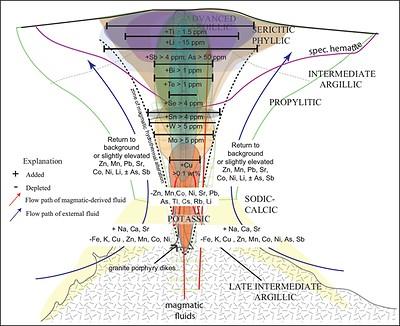
The Company submitted approximately 1,500 soil samples to ALS Chemex for gold and multi-element analysis over the 2025/26 winter period, to accurately map the vertical and lateral zonation of porphyry pathfinder elements along the Berezski Trend, and used the The University of British Columbia (“UBC”) Mineral Deposit Research Unit (” MDRU”) porphyry index (“MPIx” – Bouzari et al., 2026) to compare the elements (Cu, Mo, Sn, W) found in the deeper, high-temperature core of the porphyry, with low temperature elements (Sb, As, Ag, Tl) found at shallower levels in the system.
It is calculated using the following formula:
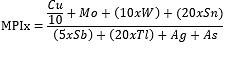
A higher MPIx number indicates closer proximity to porphyry-type mineralization, and it identified two large zones to the south and north from the drilled area that are emerging with the highest MPIx values, indicating proximity of porphyry mineralization over a very large area. Both zones are highlighted on the map below by MPIx vertical contour (blue).
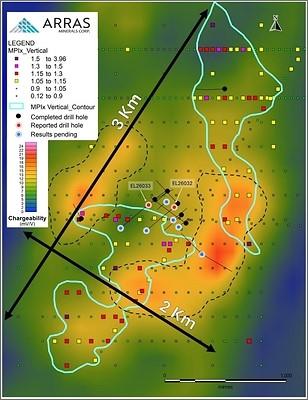
The combined data from the geophysical and geochemical surveys have expanded the Berezski North Cu-Au porphyry target to an area 3 km x 2 km. The drill results to date are demonstrating the presence of a very large-scale porphyry system (Figure 8) at this target.
All the data collected so far by Arras at Berezski North shows a very large, robust hydrothermal system. Recent drilling has intersected high-grade gold-copper mineralization from surface to depths greater than 900m, and the Company is focusing on systematically exploring this target to determine its size while at the same time, commencing definition of known mineralized zones.
Exploration Update
Four diamond drill rigs are now operating at Elemes. Two rigs are currently located at the Berezski Central Target, one rig is exploring the Novii Target and the fourth rig is drilling at K-Ozek. The Company recently completed a 362-hole KGK program, totalling over 6,000m, over the Berezski and Aimandai trends to identify additional exploration targets for follow-up exploration. Assay results from the KGK program are expected in July and will inform follow-up drill targeting in the Berezski East Target area.
Elemes Phase II Drill Program: Since June of last year, Arras Minerals has been advancing its 20,000m Phase II diamond drill program at the Elemes Project. Drilling was paused in late December for a scheduled winter break and recommenced in February. Nearly 10,000m were completed in 2025, and the strength of the results has prompted Arras to plan an expansion of the program to 30,000m, with completion targeted by the end of 2026.
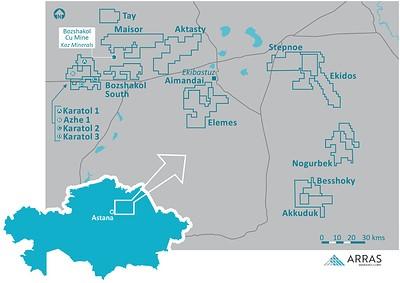
Elemes Project Overview: The Elemes Project comprises two exploration licences covering 531 square kilometres in northeast Kazakhstan, located approximately 13 km southwest of Ekibastuz and just 20 km from Arras’s operational base. The project benefits from exceptional infrastructure, with a paved highway crossing the licence, and access to 1100 KVA power lines, heavy rail, and other utilities within a 15 km radius.
Situated within the prolific Bozshakol-Chingiz metallogenic belt, Elemes lies near significant regional deposits, including the Beskauga porphyry copper-gold-silver deposit (~80 km east) and KAZ Minerals’ Bozshakol copper-gold mine (~60 km northwest), which reported mined grades in Q1 2025 of 0.39% Copper and 0.19 g/t gold.1
Geologically, the property is underlain by interbedded intermediate volcanic and sedimentary rocks intruded by multiple phases of diorite and monzodiorite porphyry. Copper-gold mineralization occurs in sheeted and stockwork quartz-chalcopyrite veins associated with these intrusions. In addition, high-grade low-sulphidation epithermal veins have been mapped on the property, representing a secondary exploration target.
Property-wide soil sampling programs defined two extensive Cu-Mo-As geochemical anomalies: the Berezski and Aimandai Trends, both considered priority targets for follow-up exploration drilling. A Phase 1 drill program on the Berezski Trend in late 2024 returned high-grade porphyry/epithermal copper and gold mineralization in results announced in Q1 2025. A 20,000m Phase 2 drill program commenced in May 2025 which was expanded to 30,000m in January 2026 and is expected to be completed by the end of 2026.
References
1KAZ Minerals Q4 2025 Production Report.
https://www.kazminerals.com/app/uploads/2026/02/Q4-2025-Production-report_FINAL_ENG.pdf
Bouzari, F; Lee, R; Hart, C; Barker, S; van Straaten, B, “Mineralogical and Geochemical Vectors Within and Around Advanced Argillic-Altered Rocks of British Columbia”, Economic Geology, March, 2026
Halley, S; Dilles, J; Tosdal, R, “Footprints: Hydrothermal Alteration and Geochemical Dispersion Around Porphyry Copper Deposits”, SEG Newsletter, January 2015
Quality Assurance and Quality Control
The Company adheres to CIM Best Practices Guidelines for exploration related activities conducted on its property. Quality Assurance and Quality Control (QA/QC) procedures are overseen by the Qualified Person.
Arras Minerals QA/QC protocols are maintained through the insertion of certified reference material (standards), blanks and field duplicates within the sample stream. Drill core is cut at Arras Minerals operations base in Ekibastuz, Kazakhstan by Company personnel. Diamond drill core was sawed in-half with a diamond saw, and then sampled in maximum 2-meter intervals, stopping at geological boundaries, with one-half placed in sealed bags and shipped to the laboratory and the other half retained on site.
Each bagged core sample was shipped to ALS Laboratory in Karaganda, Kazakhstan. Samples were dried, crushed and pulverized to >80% passing -200 mesh. The prepared sample splits were sent to the ALS Chemex’s geochemical analysis laboratories in Loughrea, County Galway, Ireland and Lima, Peru for multi-element analysis. Multielement analyses were analyzed with ICP-MS following a four-acid digestion (method ME-MS61) and samples containing >1.0% copper were analyzed via method Cu-OG62.
Gold analysis was conducted by ALS Chemex at the analytical laboratory in Karaganda, Kazakhstan. Gold was analyzed by fire assay (30 g) with an AA (atomic absorption) finish (method Au-AA23) with detection limits of 0.005 g/t gold. Samples containing greater than 10.0 g/t gold were analyzed by fire assay with a gravimetric finish (method Au-GRA21).
ALS is an accredited laboratory which is independent of the Company. Chain of custody is maintained from the drill to the submittal into the laboratory preparation facility.
Qualified Person
The scientific and technical disclosure for this news release has been prepared under the supervision of and approved by Matthew Booth, Vice President of Exploration, of Arras Minerals Corp., a Qualified Person for the purposes of NI 43-101. Mr. Booth has reviewed and approved this release. Mr. Booth has over 20 years of mineral exploration experience and is a Qualified Person member of the American Institute of Professional Geologists (CPG 12044).
Gold, copper and other mineral equivalents are calculated on the basis specifically set forth in this news release and are based upon the reasonable assumptions as to the prices of various metals and their recoveries assumed by management of the Company on a project-by-project basis as converted metal. All drill-hole intervals are reported as drill widths, as true thicknesses are unknown. Assumed metal prices are: US$3.75/lb. Copper, US$3,000/oz Gold, US$35/oz Silver, & US$30/lb Molybdenum.
The Company has updated metal recoveries: 90% for copper, 85% for gold, 75% for silver, and 80% for molybdenum. These figures are based on a review of published data from advanced-stage porphyry projects (including Vizcachitas, Los Andes Copper; Copper Creek, Faraday Copper; Valeriano, ATEX Copper; Los Helados, NGEx Resources Inc.; Opemiska, XXIX Metal Corp; Costa Fuego, Hot Chili Limited; Moonlight-Superior, US Copper Corp; Warintza, Solaris Resources, Inc.; Chita Valley, Minsud Resources Corp.; Hat, Doubleview Gold Corp.)
Copper Equivalent (“CuEq”) grades reported for the drill holes at Elemes were calculated using the following formula: CuEq % = ((Copper (%)) x 0.9) + ((Gold (g/t) x 0.8571) x 0.85) + ((Silver (g/t) x 0.0117) x 0.75) + ((Molybdenum (ppm) x 6.8568) x 0.80).
Gold Equivalent (“AuEq”) grades reported for the drill holes at Elemes were calculated using the following formula: AuEq g/t = ((Gold (g/t) x 0.85) + ((Copper (%) x 1.1667) x 0.9) + ((Silver (g/t) x 0.0136) x 0.75) + ((Molybdenum (ppm) x 8.0) x 0.80).
About Arras Minerals Corp:
Arras is a Canadian exploration and development company advancing a portfolio of copper and gold assets in northeastern Kazakhstan, including the Elemes copper-gold porphyry project where initial drill results in 2025 identified porphyry style mineralization across a 10km line of strike. The Company has established one of the largest land packages in the country prospective for copper and gold.
SAGA Metals Corp. (TSX-V: SAGA) (OTCQX: SAGMF) (FSE: 20H), a North American exploration company foc... READ MORE
Fredonia Mining Inc. (TSX-V: FRED) is pleased to announce that it has closed its previously announce... READ MORE
Legacy Gold Mines Ltd. (TSX-V: LEGY) is pleased to report assay results from core holes LG26-017 an... READ MORE
Inventus Mining Corp. (TSX-V: IVS) is pleased to report results from 100 drill holes from its now-... READ MORE
Abcourt Mines Inc. (TSX-V: ABI) (OTCQB: ABMBF) is pleased to present its operational report for the ... READ MORE