








Results include: 93m @ 0.40% Cu, 80m @ 0.39% Cu, 44m @ 0.53% Cu, and 36m @ 0.58% Cu
Midnight Sun Mining Corp. (TSX-V: MMA) (OTCQX: MDNGF) is pleased to report results from drillholes completed on its wholly owned Dumbwa copper deposit, located in Solwezi, Zambia. Dumbwa is in the southeast portion of the Company’s Solwezi Project, centered in the heart of the prolific Domes Region – flanked to the north by First Quantum’s Kansanshi mine and west by Barrick’s Lumwana mine.
Drilling has now surpassed 200 holes for a total of over 42,000 metres and results to date confirm near surface copper sulphide mineralisation, over a continuous strike length of 5.3 kilometres (see Figures 2 and 3), with assays received for the first ~4km of drilled strike. The initial discovery and delineation drill program continues with 4 rigs focussed o n growing the deposit to the north along strike and to extend previously drilled mineralisation east and west. Quality control issues related to laboratory analysis have been resolved, and the related backlog of assays are now largely caught up (see below).
The Company plans to host a technical webinar with Midnight Sun’s COO, Dr. Kevin Bonel, to discuss the results announced in this news release. Details will be included in a separate news release.
Top 20 Drill Highlights:
| Hole ID | From (m) | To (m) | Interval (m) | Cu (%) | |
| DBW-25-099R | 58 | 60 | 2 | 0.54 | |
| 152 | 245 | 93 | 0.40 | ||
| DBW-25-123 | 29 | 33.78 | 4.78 | 0.31 | |
| 59 | 67 | 8 | 0.44 | ||
| 127 | 207 | 80 | 0.39 | ||
| DBW-25-036 | 0 | 44 | 44 | 0.53 | |
| and | 119.54 | 137 | 17.46 | 0.37 | |
| DBW-25-111 | 52 | 57 | 5 | 1.75 | |
| 63 | 79 | 16 | 0.35 | ||
| 132 | 221 | 89 | 0.25 | ||
| DBW-25-122 | 11 | 20.6 | 9.6 | 0.18 | |
| 77 | 91 | 14 | 0.19 | ||
| 106 | 142 | 36 | 0.58 | ||
| including | 127 | 142 | 15 | 1.03 | |
| 171 | 238 | 67 | 0.30 | ||
| DBW-25-147 | 0 | 17 | 17 | 0.20 | |
| 41 | 102 | 61 | 0.34 | ||
| including | 41 | 47 | 6 | 1.30 | |
| 82 | 85 | 3 | 1.38 | ||
| 111 | 126 | 15 | 0.27 | ||
| 154 | 168.05 | 14.05 | 0.51 | ||
| 182 | 183 | 1 | 1.34 | ||
| DBW-25-064 | 0.7 | 47 | 46.3 | 0.42 | |
| DBW-25-114 | 26 | 32 | 6 | 0.21 | |
| 43 | 87 | 44 | 0.37 | ||
| 122 | 208.5 | 86.5 | 0.15 | ||
| DBW-25-149 | 23 | 40.84 | 17.84 | 0.85 | |
| Including | 31 | 39 | 8 | 1.71 | |
| 50.58 | 72 | 21.42 | 0.38 | ||
| 171 | 197.65 | 26.65 | 0.38 | ||
| DBW-25-110 | 42 | 77 | 35 | 0.36 | |
| 89 | 102 | 13 | 0.34 | ||
| 145 | 154 | 9 | 0.20 | ||
| DBW-25-065 | 91 | 98 | 7 | 0.16 | |
| 127 | 163 | 36 | 0.33 | ||
| DBW-25-106 | 38 | 43 | 5 | 0.19 | |
| 59 | 67 | 8 | 0.4 | ||
| 173 | 210 | 37 | 0.31 | ||
| DBW-25-031 | 27 | 36 | 9 | 0.34 | |
| 119 | 142 | 23 | 0.49 | ||
| 160 | 181 | 21 | 0.34 | ||
| DBW-25-037 | & nbsp; | 0 | 42 | 42 | 0.25 |
| DBW-25-127 | 42 | 72 | 30 | 0.32 | |
| 96 | 107 | 11 | 0.53 | ||
| 174.95 | 180 | 5.05 | 0.29 | ||
| DBW-25-117 | 42 | 46 | 4 | 0.51 | |
| 67 | 95 | 28 | 0.30 | ||
| 103 | 109 | 6 | 0.19 | ||
| 143 | 182 | 39 | 0.15 | ||
| DBW-25-120 | 13 | 19 | 6 | 0.54 | |
| 89 | 144.5 | 55.5 | 0.15 | ||
| 164 | 172 | 8 | 0.46 | ||
| DBW-25-108 | 10 | 51 | 41 | 0.20 | |
| 106 | 153 | 47 | 0.14 | ||
| DBW-25-054 | 14 | 20 | 6 | 0.19 | |
| 37 | 54 | 17 | 0.47 | ||
| including | 37 | 38 | 1 | 5.94 | |
| 64.3 | 66 | 1.7 | 0.57 | ||
| 79 | 86 | 7 | 1.01 | ||
| DBW-25-148 | 72.2 | 78 | 5.8 | 0.18 | |
| 86 | 102 | 16 | 0.17 | ||
| 119 | 139.7 | 20.7 | 0.17 | ||
| 169 | 190 | 21 | 0.33 |
“What began as a geological c oncept has now been established as a significant discovery, with over 5.3km of strike now tested and supported by more than 40,000m of drilling. Our team is rapidly defining what is emerging as an exceptionally large, near-surface, structurally controlled copper sulphide deposit,” stated COO, Kevin Bonel.
“We are developing a clear understanding of Dumbwa and can see the hallmark ‘pinch-and-swell’ geometry typical of major structurally controlled systems and have confirmed unequivocally that Dumbwa is a basement-hosted, strain-related deposit, geologically comparable in every way to Barrick’s Lumwana. We also recognize a predictable grade distribution along strike, with broader higher-grade zones separated by narrower lower-grade domains. Most importantly, we are continuing to establish meaningful scale with each step north expanding the system and mineralisation remaining open, alongside a clear plan to unlock additional mineralisation within zones identified through earlier drilling.”
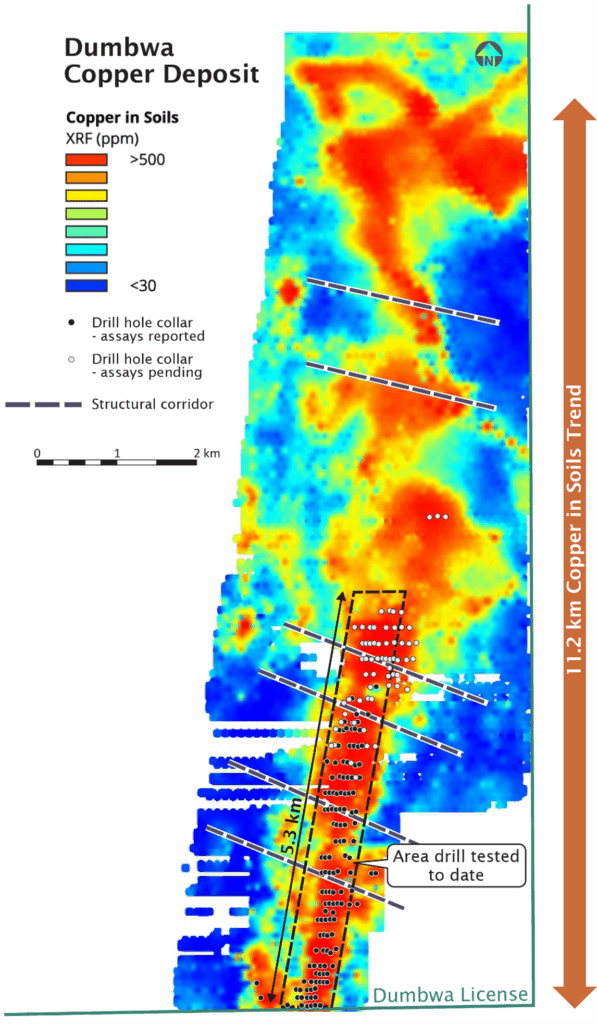
Figure 1: Dumbwa drilling to date, plotted on 11.2km Phase One copper-in-soil anomaly, target area.
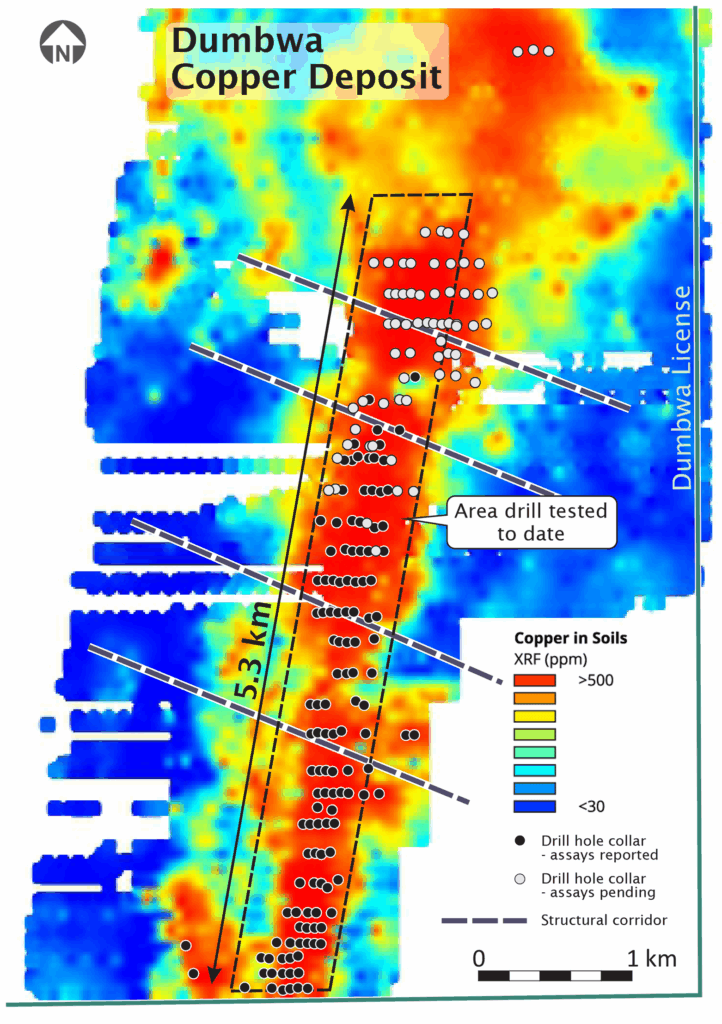
Figure 2: Dumbwa drilling to date, magnified to show current 5.3km drilled strike ext ent, plotted on Phase One copper-in-soil anomaly, target area.
Dumbwa Today – Geological Model Verified
The Company’s drilling has now surpassed 200 holes for a total of more than 42,000m over 5.3km of strike, and continues to confirm that Dumbwa is an exceptionally large, very near surface, structurally controlled copper sulphide deposit which remains open for growth. Drill testing has focussed on the upper ~220m of the deposit with the intent of defining a resource amenable to rapid, low strip ratio, low-cost future development. It is noted that some areas of similar mineralisation at the nearby Lumwana project can be traced to vertical depths well beyond 200m. At Dumbwa, east-west width of the mineralised corridor ranges from 200m to greater than 500m. Copper grades are variable ranging from thick lower grade intercepts (> 50 m @ <0.3%) to thick higher-grade intercepts (>25m@>0.5%). Grade variab ility is pronounced along strike (north-south) and is influenced by cross-cutting northwest-southeast structures that adversely affect the strain regime and subsequent development of mineralised schists. In contrast, grades are relatively consistent east-west within the higher, medium and lower grade zones, and across the width of the mineralised corridor.
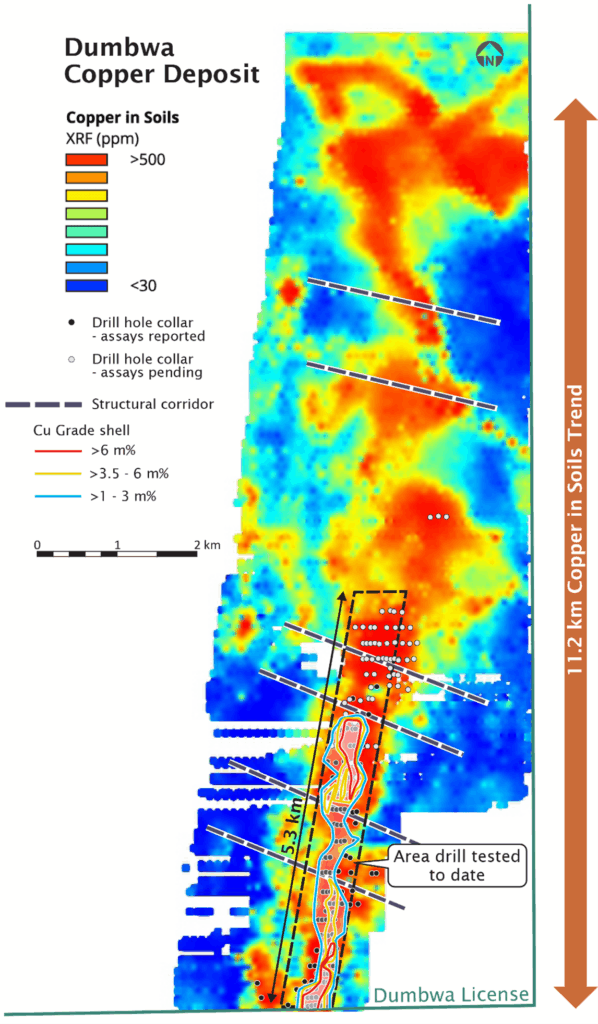
Figure 3: Assay grade shells superimposed on the Dumba soil anomaly showing the correlation between high soil anomalies and medium to high grade mi neralised intercepts at Dumbwa. Drilling continues to follow the soil anomaly north.
The First 5.3km Of Strike – In Detail
As seen in the grade distribution map, the first higher grade zone (the “TRS Block”) starts at the south concession boundary and is approximately 1,800m long, varying from 200m wide to more than 500m wide in places, with scope to increase the known mineralised envelope eastwards and at greater depth.
This is followed by a lower grade zone (“CF Block 1”) ~900m along strike and again averaging around 200m wide. Here the strain in the gneisses is observed as lower and consequently there was poor schistose lens development and weaker mineralisation, although the mineralisation remains persistent along strike.
This lower grade zone transitions into the next higher-grade portion of the deposit (the “ES Block”) which, to date, has been ext ended for 1,600m along strike at an average width of ~500m, expanding it to over twice the width of the southernmost higher-grade zone.
This brings the drill defined medium-to-high grade zones to a total strike length of 3,300m with widths varying from 200m to over 500m.
In both higher-grade zones, mineralisation depth extent has been demonstrated to start at surface and reach between 175m and 220m deep, with occasional deeper holes demonstrating mineralisation continuing to a depth greater than 300m.
Structurally, the southern part of the Dumbwa copper deposit is weakly broken by late NW-SE trending structural corridors (late brittle faulting) although offset distances are minimal. Early observations on drill core from the area north of strike kilometre 5, the area currently being tested by drilling, indicates more intense late brittle faulting and locally larger offsets, however, the relationship between high strain leading to copper mineralised schist development holds true.
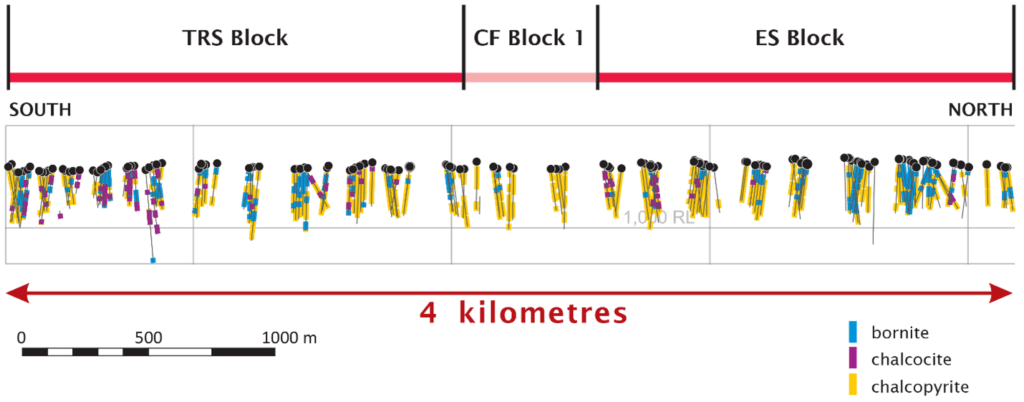
Figure 4: Long Section showing 4km mineralised strike and distribution of bornite and chalcopyrite.
Lumwana Analogue Confirmed
Detailed lithological and structural logging is showing the Dumbwa copper deposit to be a stacked series of horizontal to shallow east dipping copper sulphide mineralised biotite and biotite-muscovite schists (“2 mica schists”) within a barren grey and pink basement gneiss sequence. The schists form in an intimate relationship with strain which has resulted in the sc hists being variably developed over the 5.3 km that have been drilled to date. Simply put, increasing strain leads to greater schist development, which in turn results in higher copper sulphide concentration.
The relationship between high tectonic strain and the evolution of the copper-bearing schists is very clear, and the similarity between Lumwana and Dumbwa has been well established.
As with Lumwana, where there is both high strain and mineralised schist, a kyanitic overprint is commonly observed and these correlate with the highest grades and thickest copper intercepts observed in Dumbwa.
Dumbwa and Lumwana share extraordinary geological similarity, formed by the same basement-hosted structural and mineralisation processes:
| Lumwana | Dumbwa |
| Copper sulphide mineralised biotite and muscovite-biotite schists within a grey and pink gneiss package | Copper sulphide mineralised biotite and muscovite-biotite schists within a grey and pink gneiss package |
| Host rocks ancient basement gneisses | Host rocks ancient basement gneisses |
| Copper mineralisation related to high strain and the evolution of schists as a C1 fabric | Copper mineralisation related to high strain and the evolution of schists as a C1 fabric |
| Copper mineralisation dominated by chalcopyrite with bornite and subordinate chalcocite | Copper mine ralisation dominated by chalcopyrite with bornite and subordinate chalcocite |
| Lumwana dominated by shallow dipping (south and east) mineralised schists | Dumbwa dominated by shallow (mostly east) dipping mineralised schists |
| Lumwana mineralised schists anastamosed and intercalated with barren grey gneiss as ‘boudins and rafts’ | Dumbwa mineralised schists anastamosed and intercalated with barren grey gneiss as ‘boudins and rafts’ |
| Subsidiary sulphides dominated by pyrite (Chimiwungo) and pyrrhotite (Kamisengo) | Dumba dominated by subsidiary pyrite and rare pyrrhotite |
| Lumwana mineralised schists usually associated with a metasomatic kyanite overprint | Dumbwa mineralised schists usually associated with a metasomatic kyanite overprint |
| Lumwana Chimiwungo mineralisation extends for >4km east-west and >5km north-south, with a shallow dip to th e south. It is sheeted, continuing beyond these limits, with grades and thicknesses decreasing away from the core of the deposit. This mineralisation is still open to the east and south but pinches out to the west and is down-thrown by a series of late-stage, north-dipping, normal faults. The main body of the Chimiwungo deposit consists of multiple stacked mineralised zones, in aggregate varying from 40m to over 100m in thickness (Source: Porterhouse) |
The Dumbwa deposit extends for 200m – 500m east-west and at least 5.3km north-south with planned Phase One exploration drilling to test a further 5.7km north for a total of 11.2km of suspected north -south copper mineralised strike. Phase Two will test the northern half of the 20km copper-in-soil anomaly. Stacked mineralised zones go from surface to beyond 300m but average ~175m – 200m.
While drilling to date demonstrates Dumbwa having a narrower E-W mineralised corridor (200m-500m wide) when compared to Lumwana, the deposit remains open and has the potential for significantly greater strike length and maximum thickness than Lumwana. |
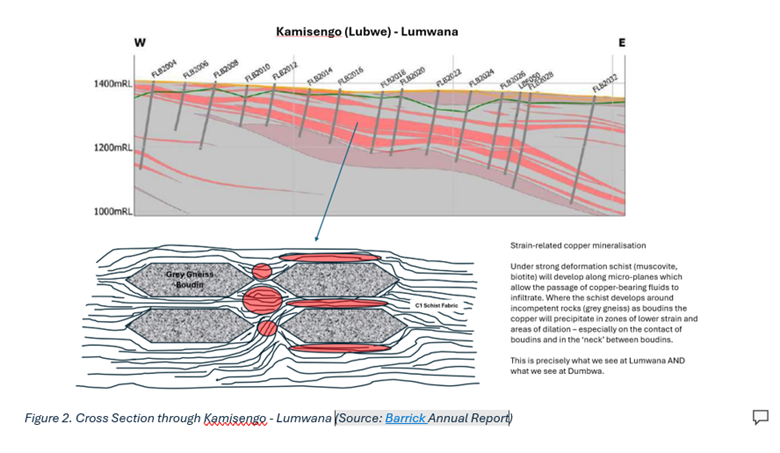
Figure 5: Cross Section through Kamisengo – Lumwana (Source: 2024 Barrick NI-43-101 Technical Report).
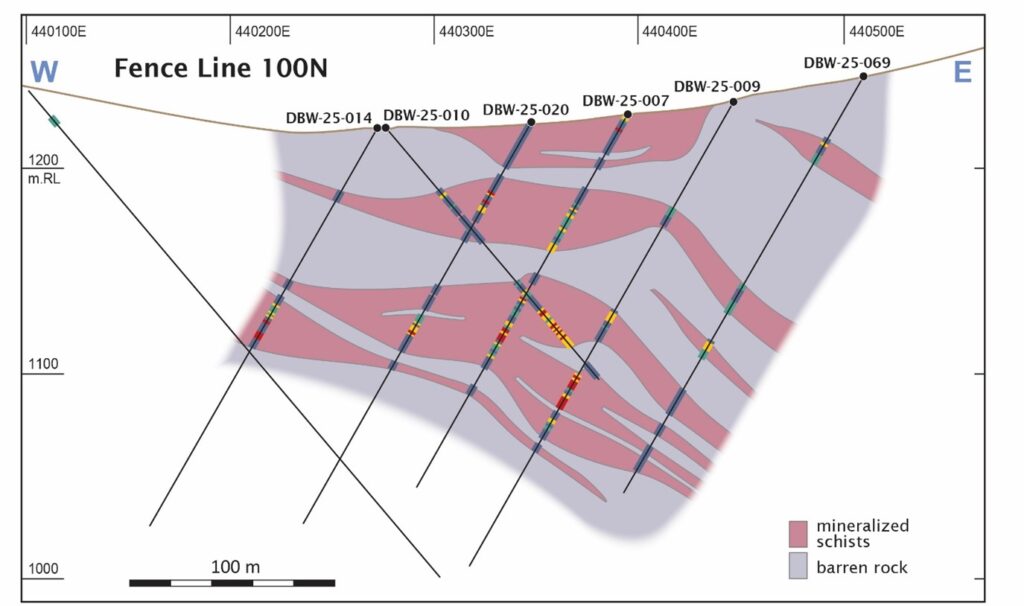
Figure 6: Cross section through Dumbwa – Line 100N demonstrating the strong similarity with the geology and mineralisation at Lumwana.
Laboratory Issues Resolved
In early February 2026, the Company encountered quality control issues with core sample assays at SGS Laboratories in Kalulushi, Zambia. These persisted across multiple batches, creating a significant backlog of assay results. SGS conducted internal audits of their laboratory and systems, which identified several contributing factors, including ICP instrument calibration issues, poor-quality argon gas supply, and complications arising from a facility relocation.
Through rigorous quality assurance and quality control protocols, Midnight Sun identified these issues as they emerged and, through persistent communication, worked with the laboratory to resolve them. SGS has since remedied the issues, with assay results now meeting Midnight Sun’s internal QA/QC standards. With the issues now resolved, the associated assay backlog has been substantially alleviated. Of the 200 holes drilled to date, including ongoing holes that have not yet been sampled, assay results for 66 holes remain pending.
The Company has also been working with Intertek Laboratories, and has dispatched recent samples for assaying to Intertek in Perth, Australia.
Dumbwa – Continued Expansion
Detailed geological cross-sections of assa y results, lithologies, and structures have indicated that some of the early drill fences located in the south part of the Dumbwa copper deposit were stopped short of fully testing the mineralised width, particularly in the southernmost high-grade zone. Further drilling is planned to test these incomplete drill fences with the expectation that the southern mineralised zone will grow eastwards, having potential to add materially to the overall deposit size.
As of this news release, the initial, broadly spaced, shallow drilling has tested approximately one third of the strike extent being targeted in the Phase One program (with assay results released for the first 4km) . Drilling will continue along the planned strike length of 11.2km in Phase One with a further 200 holes planned for an additional 40,000m of drilling, including width extensions on certain previously drilled fences.
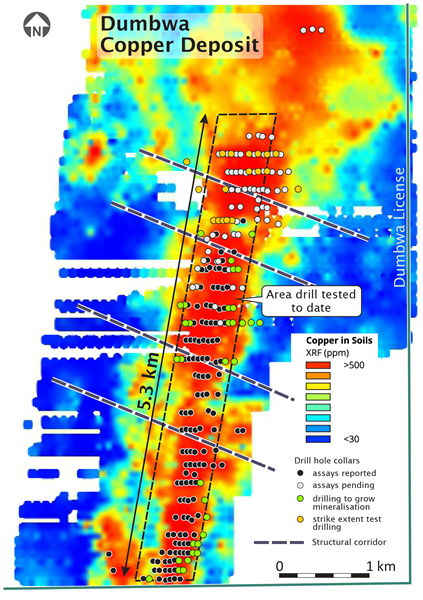
Figure 7: Planned drill holes to extend mineralised width of fences.
The Dumbwa deposit remains open to the north along the entire extent of the continuous copper-in-soil anomaly, to the east in certain areas, and to depth. Exploration work at Dumbwa, including drilling, is expected to continue on an ongoing basis.
Quality Control/Quality Assurance
Drilling was conducted using a conventional diamond drilling rig and drill core was captured for the entirety of each hole and placed into plastic core trays. All drill holes were cored in PQ until stable ground was achieved and then reduced to HQ size for the remainder of each hole. Sampling was based on visible coppe r mineralisation, and sample intervals honoured any important lithological boundaries. Core was then cut in house using a diamond saw and the right half of core was placed into a 200-micron plastic bag, assigned a unique sample number, and recorded into GeoSpark logging system. Samples always remained under the supervision of Midnight Sun staff to maintain chain of custody. All samples were then delivered to SGS Labs located in Kalulushi, Zambia, a fully accredited laboratory. Once received, the samples were sorted, dried, crushed, and pulverized (SGS code PRP90) followed by four-acid digest with ICP-OES finish (SGS Code ICP42S). Copper range of detection is 0.01-10%. Midnight Sun follows an in-house QA/QC program that consists of a random insertion every 10th sample of either a coarse blank, fine blank, coarse duplicate, fine duplicate, or Certified Reference Material (standards).
Qualified Person: Darin Labrenz, P.Geo., a consulting geologist for the Company and Qualified Person under NI 43-101, has reviewed and approved the technical data and contents of this release.
About Midnight Sun
Midnight Sun is rapidly advancing the Solwezi Copper Project, with a focus on our flagship Dumbwa copper deposit. The Project is located near the town of Solwezi in the heart of the Zambia–Congo Copperbelt, the world’s second-largest copper-producing region. This prolific mining district is renowned for hosting multiple major copper deposits, and benefits from excellent infrastructure, an established mining workforce, and a long history of successful production.
The Solwezi Copper Project is surrounded by producing copper mines, including the geologically similar Lumwana mine just west of our project and First Quantum’s Kansanshi mine – Africa’s largest integrated metallurgical processing facility, approximately 6 kilometres east of the company’s recently anno unced Kazhiba Oxide Resource. This highly favourable location highlights the district-scale potential of Midnight Sun’s land package.
The Dumbwa copper deposit underlays a robust 20-kilometre copper-in-soil anomaly, and ongoing drilling has demonstrated strong geological similarities to the nearby Lumwana mine, underscoring the potential scale of this new copper system.
Led by an experienced geological team with a proven track record of major discoveries in the Zambia–Congo Copperbelt and globally, Midnight Sun’s goal is to delineate Zambia’s next generational copper deposit.
SAGA Metals Corp. (TSX-V: SAGA) (OTCQX: SAGMF) (FSE: 20H), a North American exploration company foc... READ MORE
Fredonia Mining Inc. (TSX-V: FRED) is pleased to announce that it has closed its previously announce... READ MORE
Legacy Gold Mines Ltd. (TSX-V: LEGY) is pleased to report assay results from core holes LG26-017 an... READ MORE
Inventus Mining Corp. (TSX-V: IVS) is pleased to report results from 100 drill holes from its now-... READ MORE
Abcourt Mines Inc. (TSX-V: ABI) (OTCQB: ABMBF) is pleased to present its operational report for the ... READ MORE