






Including 5 m at 1.10% TREO from 3 m depth; MAV_AD_0035 adds a second 5 m interval at 0.83% TREO and MAV_AD_0029 ends in mineralization after 16 m from surface
Verde AgriTech Ltd. (TSX: NPK) (OTCQX: VNPKF) is pleased to announce additional assay results from 17 auger holes at its Minas Americas Global Alliance rare earths project in Minas Gerais, Brazil. The new results extend the same discovery model Verde has been building since October: shallow ionic-clay mineralization carrying an NdPr-led magnet basket with meaningful Dy/Tb support, now confirmed in additional multi-metre zones as the drill-confirmed footprint expands beyond 3.5 km².
“From the first surface results through ionic-adsorption confirmation and the PT-34 breakthrough, Minas Americas has been telling one coherent discovery story,” said Cristiano Veloso, Founder and CEO of Verde. “This batch strengthens that same story in the ways that matter most: a stronger flagship i nterval in MAV_AD_0028, a second 5 m proof interval in MAV_AD_0035, additional corroboration in MAV_AD_0042 and MAV_AD_0044, and open-ended continuity in MAV_AD_0029. We are seeing shallow thickness, repeatable internal enrichment, strong NdPr and meaningful Dy/Tb inside a growing footprint – exactly the combination we want as we advance toward a 3D model, representative metallurgical composites and, ultimately, a maiden resource.”
At this stage, the key variables are clear: shallow position, repeatable multi-metre enrichment, magnet-basket quality and growing scale. This release advances all four without changing the geological model that Verde has been reporting since the Project was first disclosed.
Highlights
Table 1: Selected Magnet-Basket and Continuity Intervals
| Hole ID | Interval (m) |
Length (m) |
TREO (ppm) |
MREO (ppm) |
NdPr Oxides (ppm) |
Dy₂O₃ (ppm) |
Tb₄O₇ (ppm) |
||
| MAV_AD_0028 | 0–10 | 10 | 8,439 | 1,965 | 1,904 | 49.4 | 11.4 | ||
| Including | 3–8 | 5 | 11,032 | 2,717 | 2,634 | 66.8 | 15.8 | ||
| MAV_AD_0035 | 6–11 | 5 | 8,273 | 2,013 | 1,950 | 50.8 | 11.4 | ||
| MAV_AD_0044 | 8–16 | 8 | 6,172 | 1,176 | 1,137 | 31.6 | 7.0 | ||
| Including | 11–16 | 5 | 6,724 | 1,450 | 1,402 | 39.4 | 8.8 | ||
| MAV_AD_0042 | 11–13 | 2 | 8,404 | 2,117 | 2,048 | 55.5 | 12.5 | ||
| MAV_AD_0029 | 0–16 | 16 | 2,869 | 541 | 519 | 18.1 | 3.8 | ||
| Including | 8–16 | 8 | 4,650 | 923 | 886 | 31.4 | 6.5 |
Why This Batch Matters
The geological model at Minas Americas is not changing; it is strengthening. The same signature already established at surface and in earlier PT-34 drilling – shallow position, an NdPr-rich magnet basket, persistent Dy/Tb and laterally continuous clay mineralization – is now repeating across a larger footprint.
What matters most in this batch is not one more isolated assay. It is that the Project now has a stronger flagship interval, a second 5 m proof interval, additional corroboration in separate holes and local continuity beyond current end-of-hole. That combination makes the discovery more defensible technically and more meaningful economically.
In the best new multi-metre intervals, magnet rare earth oxides account for roughly 22%-25% of TREO. NdPr remains the core of the basket, while Dy/Tb strengthen within the higher-grade windows. Together, grade, thickness, basket quality and continuity are all moving in the same direction.
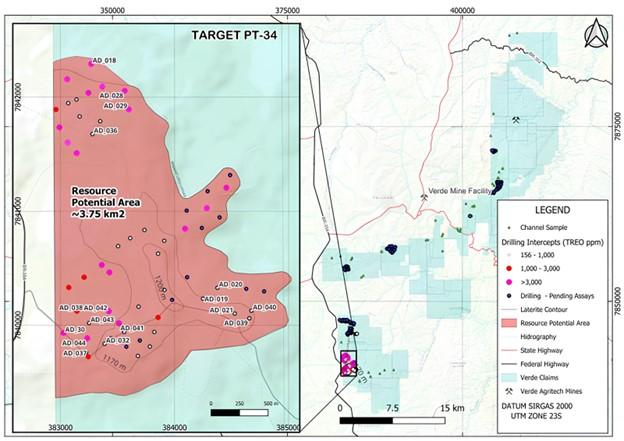
Figure 1: Drill hole plan map showing distribution of high-grade intercepts in the resource potential area.
Dy/Tb Context: High-Coercivity Magnet Metals Continue to Stand Out
In the 5 m enrich ment interval in MAV_AD_0028 (3-8 m), Dy₂O₃ averages approximately 66.8 ppm and Tb₄O₇ approximately 15.8 ppm, for a combined approximately 82 ppm Dy₂O₃ + Tb₄O₇ alongside 2,634 ppm NdPr oxides. Figure 2 places that interval in context against selected published Brazilian ionic clay projects. The comparison is provided for context only; drill intercepts are not directly comparable to resource averages because of differences in sampling, compositing, cut-off grades, domaining and reporting frameworks, and Verde has not independently verified those public disclosures.
TECHNICAL COMMENTARY
What the New Holes Are Showing
In ionic adsorption clay systems, the important technical question is whether the better magnet-basket chemistry strengthens within the same shallow domains that carry the best NdPr values. The new drilling continues to answer that question positively.
MAV_AD_0028 provides the clearest near-surface enrichment profile in this batch, and MAV_AD_0035 confirms a second 5 m zone of the same style. MAV_AD_0042 and MAV_AD_0044 add corroboration elsewhere in the system, while MAV_AD_0029 shows that mineralization remains open locally at depth.
The higher-grade internal zones are metres thick and nested within broader shallow mineralized profiles rather than appearing as narrow isolated spikes. That geometry is supportive of both 3D modelling and the selection of representative composites for metallurgical testing.
Taken together, the new holes suggest the Project is evolving the right way technically: not by changing the discovery model, but by repeating it.
Yttrium: Strategic Heavy-REE Support Repeats in the New Data
Yttrium (“Y”) is not included in MREO and should not be confused with the Project’s core magnet basket. In ionic adsorption clay systems, however, it remains relevant as broader heavy-REE support and as potential future optionality, subject to metallurgical behavior.
Across the 17 new holes, Y₂O₃ exceeds 100 ppm over approximately 26 m across five holes – MAV_AD_0028, MAV_AD_0029, MAV_AD_0035, MAV_AD_0042 and MAV_AD_0044. In the flagship hole MAV_AD_0028, the 5 m enrichme nt interval (3-8 m) averages approximately 196 ppm Y₂O₃, with Y₂O₃ remaining above 100 ppm from surface to 9 m.
The same pattern repeats in MAV_AD_0035, MAV_AD_0042 and MAV_AD_0044, showing that the strongest magnet-basket zones are also carrying broader heavy-REE support.
Previously reported hole MAV_AD_0002 remains the high-water mark at 606 ppm Y₂O₃ over 9.0-10.0 m, alongside Dy₂O₃ 86 ppm and Tb₄O₇ 17 ppm. Taken together, the old and new data suggest yttrium is part of the Project’s broader heavy-REE profile, while any future contribution to product value will depend on metallurgical behavior.
Scale and Next Steps
PT-34 remains the Project’s initial drilling anchor, with significant intercepts spanning approximately 1.7 km based on the maximum collar-to-collar distance among holes returning continuous mineralization of at least 0.40% TREO over at least 3 m. The current batch extends that same signature beyond th e original anchor area.
Across Minas Americas, the drill-confirmed footprint now exceeds 3.5 km² within a mapped and surface-sampled geological unit exceeding 15 km². Drilling remains underway across eight additional targets, suggesting the area drilled to date may still represent only a portion of the broader system.
Next work will focus on integrating the new results into the 3D geological model, selecting representative composite intervals for metallurgical testing, and continuing step-out drilling across additional targets.
TECHNICAL NOTES
QUALIFIED PERSON
The scientific and technical informat ion contained in this news release has been reviewed and approved by Leonardo Deringer Fraga, P.Geo, Vice President of Exploration, who is a Qualified Person as defined by NI 43 101 – Standards of Disclosure for Mineral Projects. EGBC License No. 61611.
QA/QC
Analyses were performed by SGS Geosol (Vespasiano, Brazil) using lithium-borate fusion with ICP-MS/OES (IMS95A/ICP95A method). The Company’s quality assurance and quality control program includes the regular insertion of blanks, certified reference materials, and duplicates into the sample stream. Analytical results are reviewed for accuracy and precision prior to disclosure.
ABOUT VERDE AGRITECH
Verde AgriTech is a specialty multi-nutrient potassium fertilizer innovator and producer, dedicated to advancing sustainable agriculture through the development and commercialization of low-carbon fertilizer products. The Company is leveraging its long-establ ished operational platform in Minas Gerais, Brazil—including people, infrastructure, laboratory capability, and permitting experience—to advance both its core fertilizer business and the exploration of critical minerals opportunities within its long-held mineral rights.
Scandium Canada Ltd. (TSX-V: SCD) is pleased to announce additional assay results from the 2... READ MORE
Search Minerals Inc. (TSX-V: SMY) (OTC Pink: SHCMF) is pleased to announce that it has closed the th... READ MORE
Golden Spike Resources Corp. (CSE: GLDS) (OTCQB: GSPRF) (FSE: L5Y) is pleased to announce the... READ MORE
GoldHaven Resources Corp. (CSE: GOH) (OTCQB: GHVNF) (FSE: 4QS) is pleased to announce that it has cl... READ MORE
Independence Gold Corp. (TSX-V: IGO) (OTCQB: IEGCF) (FSE: 625) is pleased to announce assay r... READ MORE