








Highlights:
Q2 Metals Corp. (TSX-V: QTWO) (OTCQB: QUEXF) (FSE: 458) is pleased to report the remaining analytical results from the 2025 drill program at the Company’s Cisco Lithium Project, located within the greater Nemaska traditional territory of the southernmost part of the Eeyou Istchee James Bay region of Quebec, Canada.
A total of 74 drill holes for 31,961 metres will inform the Company’s inaugural inferred Mineral Resource Estimate at the Cisco Project.
The results reported herein represent 5,587.7 m of drilling over nine (9) drill holes completed during the 2025 Drill Program. Pegmatite intervals and analytical results are reported as they are received and reviewed.
“With the release of these final drill results for 2025, we are now moving into a new chapter in the development of the Cisco Project. These assay results once again showcase the robust mineralization at Cisco and give serious emphasis to its expansion potential. Drill hole 73, located in the central portion of the Mineralized Zone, returned consistently higher grades than expected,” said Neil McCallum, Q2 Metals Vice President of Exploration. “We look forward to further infill drilling in these areas to understand the extent of a potentially higher-grade zone along strike or vertically.”
The Company published an Exploration Target in July 2025 on the main mineralized zone. The Exploration Target estimated a range of potential lithium mineralization of 215 to 329 million tonnes at a grade ranging from 1.0 to 1.38% Li2O, based only on the first 40 holes drilled. An Exploration Target is used to provide a conceptual estimate of the potential quantity and grade of a mineral deposit, based on known and additional limited geological evidence. It is an early-stage assessment that will help to guide further exploration, but it is not a mineral resource or mineral reserve and should not be treated as such.
Drilling in the latter half of 2025 prioritized infill-scale drilling utilizing four drill rigs within the Mineralized Zone. The tightened drill spacing was designed to support the Company’s objective of delivering an initial inferred MRE on the Cisco Project in the first quarter of 2026.
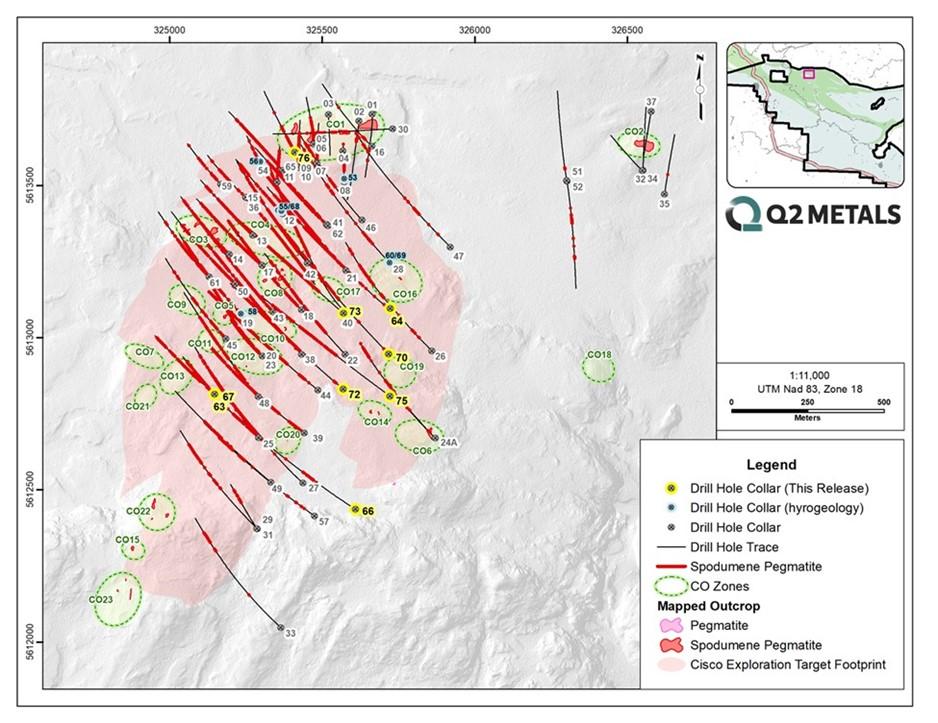
Figure 1. Updated Map of Recent Drill Holes at Cisco Project
Drill Results Discussion
Noteworthy analytical results reported herein are as follows:
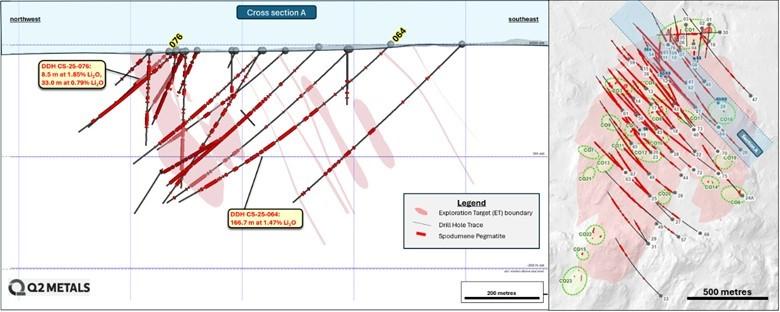
Figure 2. Cross-Section A
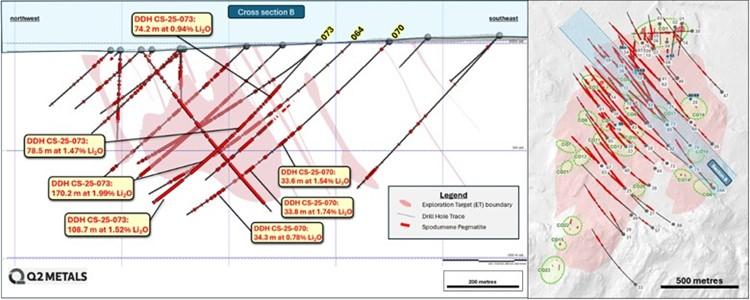
Figure 3. Cross-Section B
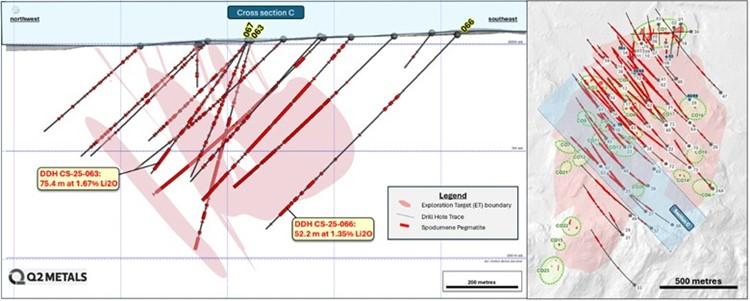
Figure 4. Cross-Section C
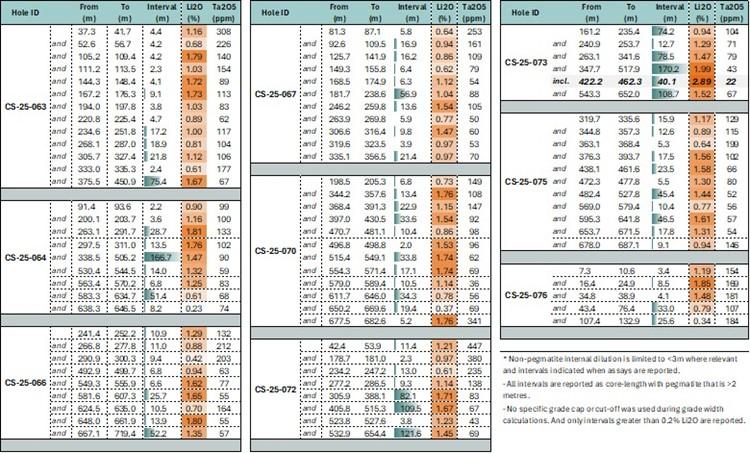
Table 1. Summary of Analytical Results of Drill Holes at Cisco Project
All intervals of greater than 2 m of core-length and greater than 0.30% Li2O are included in Table 1. Internal dilution of non-pegmatite material was limited to intervals of less than 3 m. No specific grade cap or lower cut-offs were used during grade and width calculations. All intervals are reported as core widths and mineralized intervals in all the holes drilled thus far are not representative of the true width as the modelled pegmatite zones are being refined with every additional hole.
Drill Hole Collar Information
The summary of drill holes including basic location and dip/azimuth is detailed below (Table 2).
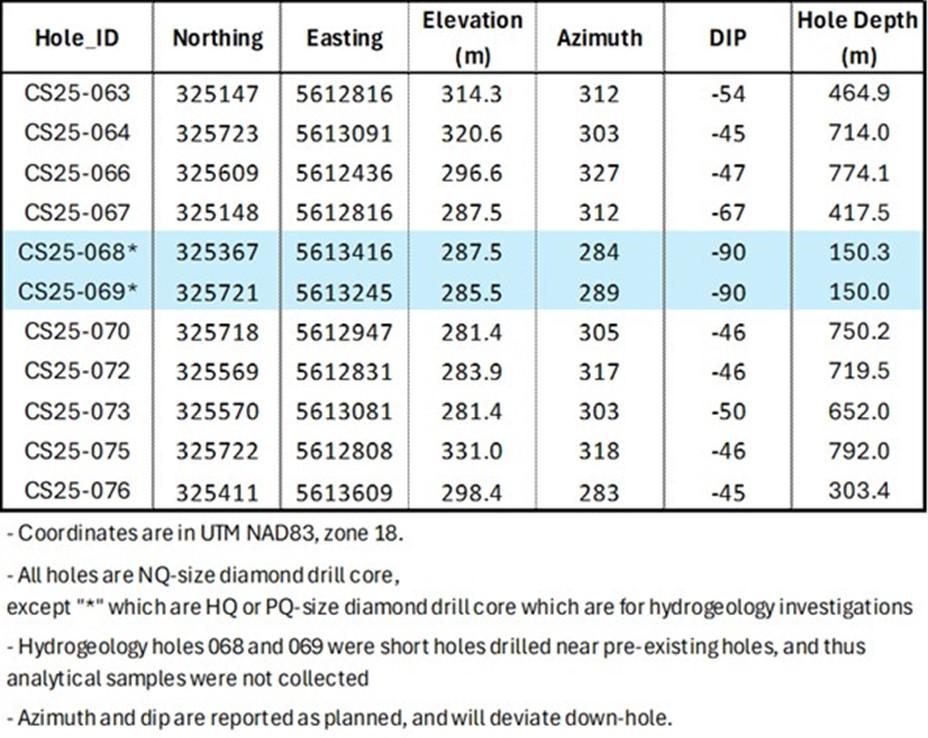
Table 2. Summary of Drill Hole Collar Information, Cisco Project
2026 Exploration Program Update
The 2026 drill campaign at the Cisco Lithium Project started in late January with four drill rigs. The primary focus of the drill campaign will be on continued infill drilling of the Mineralized Zone which is the subject of the inferred MRE anticipated to be published in Q1 2026. Infill drilling of the Mineralized Zone will inform an update to the MRE as well as a Preliminary Economic Assessment that is being targeted for late 2026. Exploration drilling will also be incorporated to test the expansion potential of areas outside of the Mineralized Zone.
Sampling, Analytical Methods and QA/QC Protocols
All drilling was conducted using diamond drill rig with NQ sized core and all drill core samples are shipped to SGS Canada’s preparation facility in Val D’Or, Quebec, for standard sample preparation (code PRP92) which includes drying at 105°C, crushing to 90% passing 2 mm, riffle split 500 g, and pulverize 85% passing 75 microns. The pulps are then shipped by air to SGS Canada’s laboratory in Burnaby, BC, where the samples are homogenized and subsequently analyzed for multi-element (including Li and Ta) using sodium peroxide fusion with ICP-AES/MS finish (code GE_ICM91A50). The reported Li grade will be multiplied by the standard conversion factor of 2.153 which results in an equivalent Li2O grade. Drill core was saw-cut with half-core sent for geochemical analysis and half-core remaining in the box for reference. The same side of the core was sampled to maintain representativeness.
A Quality Assurance / Quality Control protocol following industry best practices was incorporated into the sampling program. Measures include the systematic insertion of quartz blanks and certified reference materials into sample batches at a rate of approximately 5% each. Additionally, analysis of pulp-split and reject-split duplicates was completed to assess analytical precision. The QP has verified the QA/QC results of the analytical work.
Qualified Person
Neil McCallum, B.Sc., P.Geol, is a Qualified Person as defined by NI 43-101, and a registered permit holder with the Ordre des Géologues du Québec and member in good standing with the Professional Geoscientists of Ontario. Mr. McCallum, a director and Vice President Exploration for Q2 Metals, has reviewed and approved the technical information in this news release.
ABOUT Q2 METALS CORP.
Q2 Metals is a Canadian mineral exploration company advancing the Cisco Lithium Project, located within the greater Nemaska traditional territory of the Eeyou Istchee, James Bay region of Quebec, Canada. The known mineralized zone at Cisco is just 6.5 km from the Billy Diamond Highway, which leads to the railhead in the Town of Matagami, ~150km to the south.
The Cisco Project has district-scale potential with an initial Exploration Target estimating a range of potential lithium mineralization of 215 to 329 million tonnes at a grade ranging from 1.0 to 1.38% Li2O, based only on the first 40 holes drilled. It is noted that the potential quantity and grade of the Exploration Target are conceptual in nature and there has been insufficient exploration to estimate and define a Mineral Resource, as defined by NI 43-101. It is uncertain if further exploration will result in the target being delineated as a Mineral Resource.
The 2026 Exploration Program is ongoing, primarily focused on continued infill drilling towards indicated resource definition for inclusion in a Preliminary Economic Assessment, targeted for late 2026. Expansion and exploration drilling continues at the main zone, which remains open at depth and along strike, as well as at high potential targets identified across the broader 41,253 hectare project area.
Goliath Resources Limited (TSX-V: GOT) (OTCQX: GOTRF) (FSE: B4IF) is pleased to report assay result... READ MORE
Americas Gold and Silver Corporation (TSX: USA) (NYSE American: USAS) a North American prod... READ MORE
Cartier Resources Inc. (TSX-V: ECR) (FSE: 6CA) (OTCQB: ECRFF) is pleased to announce the results of... READ MORE
Oreterra Metals Corp. (TSX-V: OTMC) (OTCQB: OTMCF) (FSE: D4R0) (WKN: A421RQ) is pleased to report t... READ MORE
NevGold Corp. (TSX-V:NAU) (OTCQX:NAUFF) (Frankfurt:5E50) is pleased to announce additional oxide-gol... READ MORE