








The Prospector News

0.8m @ 127 g/t AuEq in Surface Sampling and 5.0m @ 4.9 g/t AuEq in Drilling at Great Pacific Gold’s Wild Dog Project

You have opened a direct link to the current edition PDF

Open PDF Close
Uncategorized

Share this news article

0.8m @ 127 g/t AuEq in Surface Sampling and 5.0m @ 4.9 g/t AuEq in Drilling at Great Pacific Gold’s Wild Dog Project


Great Pacific Gold Corp. (TSX-V: GPAC) (OTCQX: GPGCF) (FSE: V3H) announces results from its expanded Phase 1 diamond drill program at its flagship Wild Dog Project, located on the island of New Britain, East New Britain Province, Papua New Guinea.


Key Highlights:


  • Sampling of Exposed Vein Structures in Southern Oxide Area:
    • 0.8 m @ 127 g/t AuEq from Main Vein sample WDGS-036 (122 g/t Au, 2.7% Cu, 88 g/t Ag)
    • 2.4 m @ 22 g/t AuEq from Main Vein sample WDGS-027, 028, 029 (17.2 g/t Au, 2.3% Cu, 94 g/t Ag).
  • Hole WDG-09 intercepted:
    • 5.0 m @ 4.91 g/t AuEq from 169m (4.49 g/t Au, 0.21% Cu, 7.6 g/t Ag);
    • Including: 2.0m @ 11.1 g/t AuEq from 169m (10.3 g/t Au, 0.41% Cu, 15.0 g/t Ag), and
    • 2.6 m @ 6.62 g/t AuEq from 182.4m (2.74 g/t Au, 2.16% Cu, 42.96 g/t Ag).
  • Second drill rig being mobilized: additional camp capacity is being developed to support the second rig at the Wild Dog site.
  • LiDAR survey completed with results due October 6, 2025: High-precision fixed-wing airborne LiDAR and large-format imagery survey covering 187 km² across the Wild Dog district has been completed. The program will generate a Digital Terrain Model with sub-10 cm vertical accuracy, providing critical topographic control for geological modelling, drill planning, and infrastructure layout. The dataset will also support structural mapping and refine target definition across the broader Wild Dog corridor.


“Hole 9 was drilled approximately 30m to the north of hole 7, into an area where we had very little information,” stated Greg McCunn, CEO. “The intercept with the main Wild Dog structure supports the continuity of the system. With hole 10 also intercepting the main structure a further 70 meters north (assays pending), we are increasingly confident in our geological model that is supporting the Phase 1 drill program. With the second rig being mobilized, we are expecting to accelerate the completion of the planned 28 holes at Sinivit which are providing valuable information on vein orientation allowing us to start testing the system at depth. Mobile MT geophysics has highlighted significant potential at depth and along strike to both the North and South from Sinivit on the large-scale epithermal Wild Dog corridor.”


“The recent mapping and sampling campaign in the historic Southern Oxide pit area was undertaken to support modeling of the vein structures intersected in drill holes WDG-03, 04, 05 and 06 earlier in the Phase 1 program. The high-grade results in the veins exposed in the historic pit confirm the high-grade nature of the system.”


Wild Dog Phase 1 Diamond Drill Program


The Phase 1 program commenced in May 2025 and is designed to test the Sinivit target, a 1.5 km strike length within the 15 km Wild Dog epithermal vein structural corridor (Figure 1). The high-grade nature of the system has already been confirmed by multiple strong intercepts.


In addition, recent processing of MobileMT geophysical data has highlighted the exceptional scale of the epithermal system and the potential for a major porphyry copper-gold system adjacent to the veins – a setting analogous to the Wafi-Golpu deposit in PNG (mineralization at Wafi-Golpu is not necessarily indicative of mineralization at Wild Dog).


The expanded program now totals 28 diamond drill holes and is expected to continue into early 2026. Drilling to date has only tested a small portion of the mineralized corridor, which remains open to the north, south, and at depth. A second drill rig is in the process of being mobilized to site.
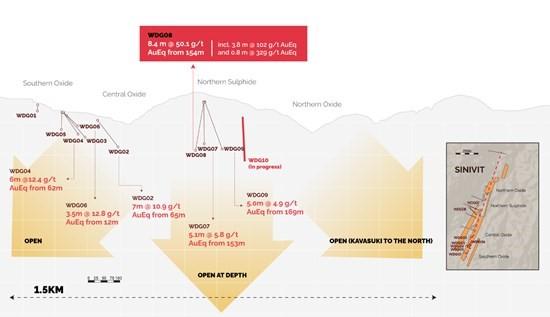
 

Figure 1: Long section through the Sinivit target area showing drilling completed to-date with key intervals.


Since commencing in May 2025, GPAC has completed ten drill holes at Sinivit. Hole WDG-10 experienced poor core recovery within the main Wild Dog structure, which was intercepted from 173 meters to 185 meters. Although samples have been collected and submitted for assay, a decision was made to re-drill the hole to ensure full recovery of the target zone, and WDG-10A is well underway and currently at 165 meters depth. Details of the drilling are shown in Table 1 with key assay results received to-date are shown in Table 2.


Results


Table 1: Wild Dog Drill Hole Details (PNG94 UTM coordinates).


Hole ID Easting Northing RL Dip Azi Max Depth
(m)
Status
WDG-01 394358.3 9488853.5 945 -50 115 40.1 Abandoned
WDG-02 394426.0 9489024.2 900 -53 050 124.6 Completed
WDG-03 394384.9 9488926.5 924 -50 053 127.6 Completed
WDG-04 394384.8 9488926.5 924 -50 75 120.6 Completed
WDG-05 394384.8 9488926.5 924 -50 116 105.9 Completed
WDG-06 394428.6 9488923.1 911 -50 352 69.0 Completed
WDG-07 394457.5 9489375 993 -61 114 201.3 Completed
WDG-08 394455.5 9489373.0 993 -57 127 224 Completed
WDG-09 394459.5 9489374.0 993 -58 85 203 Completed
WDG-10 394475.1 9489484 965 -58 114 220 Completed
WDG-10A 394475.1 9489484 965 -57 114 TBD In progress


Table 2: Wild Dog Drill Hole Key Assay Results (WDG-02 to WDG-08 results previously announced).


Hole ID From
(m)
To
(m)
Interval1 (m) Gold
(g/t)
Silver
(g/t)
Copper (%) Gold Eq.2
(g/t)
WDG-02 65.0 72.0 7.0 5.49 68.84 2.96 10.91
including 65.0 67.0 2.0 10.73 114.64 2.23 15.53
WDG-03 102.0 104.3 2.3 1.68 6.48 0.12 1.94
including 103.55 104.3 0.75 4.05 10.90 0.17 4.45
WDG-04 62.0 68.0 6.0 8.31 27.56 2.37 12.35
including 64.0 68.0 4.0 12.25 36.76 1.71 15.35
including 64.0 66.4 2.4 19.76 57.75 2.59 24.48
WDG-05 72.0 77.0 5.0 1.28 11.71 0.25 1.80
including 72.0 75.0 3.0 1.91 15.36 0.31 2.58
WDG-06 12.0 15.5 3.5 4.61 48.36 4.86 12.79
including 13.7 14.3 0.6 7.44 73.40 10.42 24.61
WDG-07 153.0 163.0 10.0 2.99 10.92 0.32 3.61
including 153 158.1 5.1 4.77 14.54 0.54 5.79
WDG-07 172.0 173.2 1.2 7.30 93.5 1.14 10.17
including 172.5 173.2 0.7 12.00 178.0 1.94 17.10
WDG-08 154 162.4 8.4 46.46 59.63 1.90 50.12
including 154 157.8 3.8 93.30 128.72 4.74 102.2
including 157 157.8 0.8 322.0 84.5 4.26 329.65
WDG-08 180 188 8 1.95 4.19 0.13 2.20
including 180 184 4 3.32 3.71 0.16 3.62
WDG-09 169 174 5 4.49 7.60 0.21 4.91
including 169 171 2 10.31 15.0 0.41 11.13
WDG-09 182.4 185.0 2.6 2.74 42.96 2.16 6.62
including 182.8 184.3 1.5 4.17 41.87 1.89 7.61

Notes:

  1. Drill highlights presented above are core lengths (true widths are not known at this time).
  2. Gold equivalent (AuEq) exploration results are calculated using longer-term commodity prices with a copper price of US$4.50/lb, a silver price of US$27.50/oz and a gold price of US$2,000/oz. No metallurgical testing has been carried out on Wild Dog mineralized samples. For AuEq calculations, recovery assumptions of Au 92.6%, Ag 78.0%, and Cu 94.0% were used based on K92 Mining’s stated recovery results in an Updated Definitive Feasibility Study for the Kainantu mine.


WDG-09 Summary


Hole WDG-09, drilled approximately 30 metres north of WDG-07, successfully intersected the main Wild Dog structure and returned 5.0 metres at 4.9 g/t AuEq from 169 metres, including 2.0 metres at 11.1 g/t AuEq. A second mineralised zone was encountered between 182.4 and 185.0 metres, averaging 2.6 metres at 6.6 g/t AuEq, including 1.5 metres at 7.6 g/t AuEq. This deeper interval contained exceptionally high copper values, with assays up to 5.5% Cu accompanied by elevated silver grades, reflecting the presence of bornite and chalcopyrite observed in core. The mineralisation is hosted within banded quartz-silica breccias and vein material, consistent with the high-sulphidation epithermal style recognised at Sinivit. These results confirm continuity of the Wild Dog system to the north, while also highlighting the potential zonation within the structure, where in this case a high-grade gold shoot is underlain by copper-silver rich sulphide domains. Importantly, the combination of strong Au, Cu, and Ag values supports the potential for vertically extensive mineralized shoots, strengthening the broader geological model and demonstrating the prospectivity of the Wild Dog vein corridor at depth.
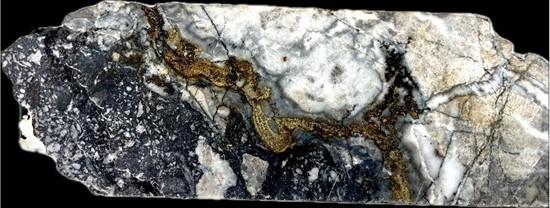
 

Figure 2: Drill core from Hole WDG-09 (182.5 m) illustrating a quartz-silica breccia cut by a colloform banded sulphide vein. Massive chalcopyrite with associated bornite occurs as coarse infill along the vein margins and in open spaces, overprinting black silica breccia clasts. This mineral assemblage is characteristic of a high-sulphidation epithermal system and corresponds to assays returning multi-percent copper and elevated Au-Ag values from this interval.
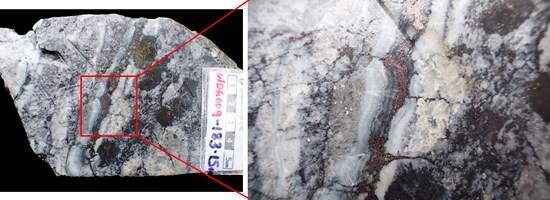
 

Figure 2: Drill core from Hole WDG-09 (183.15 m) displaying colloform banded quartz-silica veining with coarse-grained sulphide mineralisation. Bornite occurs as blebs and bands with associated chalcopyrite along quartz vein margins and in the matrix.


Southern Pit Rock Chip Sampling


On September 10, 2025, GPAC geologists undertook a sampling and mapping campaign in the historic Southern Oxide Pit area. Wild Dog main Vein structures which were intercepted in drill holes WDG-03, 04, 05 and 06 outcrop in the historic pit area and sampling and mapping was undertaken to support modelling of the veins in the area.


In total, seventeen samples were collected. In the west wall of the historic South Oxide Pit, the main vein can be observed (Figure 3).
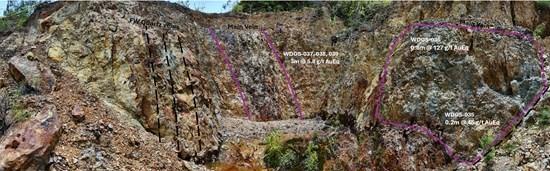
 

Figure 3: Photo of sample location for WDGS-036 which returned 0.8 meters at 127 g/t AuEq. The main vein in this area shows black silica, grey-white quartz with chalcocite, bornite and chrysocolla.


In the east wall of the historic South Oxide Pit, the main vein can also be observed (Figure 4).
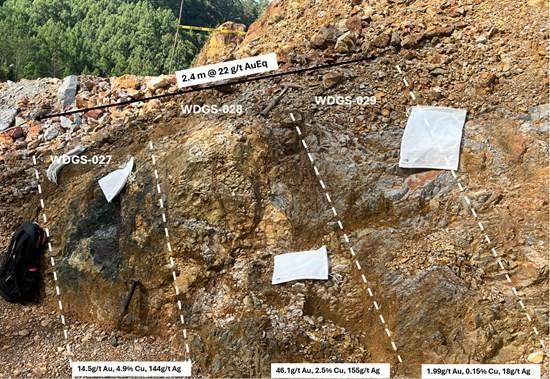
 

Figure 4: Photo of outcrop of main vein location for samples WDGS-027, 028, and 029 which returned 2.4 meters at 22 g/t AuEq. Black silica with stage 2 quartz veining is evident in sample WDGS-027 with predominantly white quartz with chalcopyrite in WDGS-028.


Qualified Person


The technical content of this news release has been reviewed, verified and approved by Callum Spink, the Company’s Vice President, Exploration, who is a member of the Australian Institute of Geoscientists, MAIG, and a Qualified Person as defined by National Instrument NI 43-101 Standards of Disclosure for Mineral Projects. Mr. Spink is responsible for the technical content of this news release. Mr. Spink is not independent of the Company.


Quality Assurance / Quality Control


The Company adheres to industry best practices for Quality Assurance and Quality Control. Drill core samples were submitted to Intertek Minerals Ltd. in Lae, Papua New Guinea, an ISO 9001-certified laboratory. Samples were securely sealed in poly-weave bags with single-use tie-locks to maintain chain of custody. Analytical testing was completed using fire assay with additional multi-element MS48 analysis underway.


Diamond drill hole WDG-02 was drilled using a combination of HQ and PQ diameter core, while the remainder of the holes were drilled with PQ. Certified reference materials (standards) and blanks were inserted into the sample stream in accordance with industry-standard protocols. Blanks were routinely inserted after high-grade intervals, and certified standards were included at a frequency of at least 5%. All assay batches received to date have passed QAQC review and fall within acceptable tolerance limits. Core recoveries for all holes were within acceptable ranges, with sampling procedures carefully managed in intervals where ground conditions were variable or fragile.


Preliminary copper assays are reported from assay results generated by aqua regia digestion and atomic absorption (AA) copper determination. The results are updated with assay results using MS48 (metallic screen fire assay) with four-acid digestion and atomic adsorption spectroscopy for copper determination.


About Great Pacific Gold


Great Pacific Gold’s vision is to become the leading gold-copper development company in Papua New Guinea. The Company has a portfolio of exploration-stage projects in PNG, as follows:

  • Wild Dog Project: the Company’s flagship project is located in the East New Britain province of PNG. The project consists of a large-scale epithermal target, the Wild Dog structural corridor, stretching 15km in strike length and potentially over 1,000 meters deep based on a recent MobileMT geophysics survey. The survey also highlighted the Magiabe porphyry target, adjacent to the epithermal target and potentially 1,000 meters in diameter and over 2,000 meters deep. Drilling of the epithermal structure on the Sinivit target has yielded high-grade results, including WDG-02 which intercepted 7.0 meters at 11.2 g/t AuEq from 65 meters. The current drilling program will extend into 2026 with 5,000 meters planned over 28 holes.
  • Kesar Project: located in the Eastern Highlands province of PNG and contiguous with the mine tenements of K92 Mining Inc. (“K92”), the Kesar Project is a greenfield exploration project with several high-priority targets in close proximity to the property boundary with K92. Multiple epithermal veins at Kesar are on strike and have the same orientation as key K92 deposits, such as Kora. Exploration work to date by the Company at the Kesar Project has shown that these veins have high grades of gold present in outcrop and very elevated gold in soil grades, coincident with aeromagnetic highs. The Company conducted a diamond drill program on key target areas at the Kesar Project from November 2024 to May 2025 and are working on developing a follow-up Phase 2 program for Q1 2026.
  • Arau Project: also located in the Eastern Highlands province of PNG, the Arau Project is south of and contiguous to the mine tenements of K92. Arau contains the highly prospective Mt. Victor exploration target with potential for a high sulphidation epithermal gold-base metal deposit. A Phase 1 Reverse Circulation drilling program was completed at Mt. Victor in August 2024, with encouraging results. The Arau Project includes the Elandora licence, which also contains various epithermal and copper-gold porphyry targets.


The Company also holds the Tinga Valley Project in PNG.


Posted September 24, 2025

Share this news article

MORE or "UNCATEGORIZED"


Critical Metals Corp Achieves Breakthrough Tanbreez Heavy Rare Earth Results: >99% Dissolution of Eudialyte Concentrate Into 19 Ultra-High-Purity Rare Earth Products; Refinery Study Projects US$1.8–2.2b in Annual Refinery Revenue

Critical Metals Corp. (Nasdaq: CRML) a leading critical minerals ... READ MORE

September 16, 2026

Metalsource Mining Extends High Grade Mineralization at Depth as Silver Hill Exploration Enters Major Expansion Phase

Holes SH26-22 and SH26-23 return up to 930 g/t AgEq within broade... READ MORE

September 16, 2026

Pasinex Completes Sale of High-Grade Zinc Sulphide Material and Provides Pinargozu Operations Update

Pasinex Resources Limited (CSE: PSE) (FSE: PNX) a growing zinc-fo... READ MORE

September 16, 2026

Aya Gold & Silver Reports High-Grade Silver Exploration Results Near Pit and at Depth at Zgounder

Aya Gold & Silver Inc. (TSX: AYA; NASDAQ: AYA) is pleased to... READ MORE

September 16, 2026

New Break Resources Ltd. (CSE: NBRK) (OTCQB: NBRKF) (FSE: O91) has received results from the last four holes of a ten-hole, 1,996 metre summer drilling program in the Zavitz gold zone at the Company's 100% owned Moray gold project. In total, New Break has completed 5,372 metres of drilling in 32 drillholes in 2026. Moray is located 49 km southeast of Timmins, Ontario and 32 km northwest of the Young-Davidson gold mine operated by Alamos Gold Inc. Select results from the final four of ten holes drilled in the summer drilling program are presented below in Table 1, while drillhole collar locations are detailed in Table 2 in Appendix A. Table 1 – Moray Summer 2026 Final Drill Results Hole ID Length (m) From (m) To (m) Width (1) (m) Au Grade (2) (g/t) NBR-26-29 322.0 77.3 78.8 1.5 0.42 and 138.0 139.1 1.1 0.38 and 162.5 173.3 10.8 (3) 1.61 and 227.4 229.0 1.6 1.21 and 231.5 232.1 0.6 1.72 NBR-26-30 250.0 37.0 38.0 1.0 0.30 and 102.8 103.5 0.7 0.60 and 121.5 122.5 1.0 0.36 and 124.5 125.5 1.0 0.33 and 128.5 129.0 0.5 0.90 and 131.0 132.0 1.0 0.36 and 169.8 174.0 4.2 2.65 and 178.0 179.5 1.5 0.77 and 183.5 186.6 3.1 1.22 and 190.0 190.5 0.5 1.06 and 191.5 192.5 1.0 1.48 and 196.0 200.5 4.5 2.53 and 203.5 204.0 0.5 2.15 and 206.5 212.0 5.5 1.57 NBR-26-31 274.0 169.0 170.5 1.5 0.37 and 184.5 186.0 1.5 0.51 and 197.0 200.0 3.0 0.94 and 201.5 202.0 0.5 0.50 and 203.5 210.0 6.5 (3) 3.12 NBR-26-32 352.0 73.5 74.0 0.5 0.44 and 174.0 174.6 0.6 0.52 and 194.0 195.0 1.0 0.66 and 199.8 203.3 3.5 2.29 and 227.3 228.0 0.7 0.97 (1) Intervals are drill intersections and do not necessarily represent true widths. (2) All intervals are presented using a cut-off grade of 0.3 g/t Au and internal dilution of no more than 1.0 metres at grades less than 0.3 g/t Au and assays are not capped (see QA/QC Procedures). (3) Drill core photos shown in Appendix B. Figure 1 – Newly Reported Drillholes NBR-26-29, 30 Figure 2 – Newly Reported Drillholes NBR-26-30, 31, 32 Note: The bottom of NBR-26-30 deviated southeast and is represented in both sections. Figure 1: Section B-B1 incorporates drillholes NBR-26-06, 07, 08, 25, 26, 27, 28, 29 and part of 30. Gold mineralization extends southeast into the syenite as exhibited in NBR-26-29. NBR-26-30 is identified in both sections A-A1 and B-B1 as the drillhole was collared along section A-A1 but deviated southeast, intersecting gold mineralization in the mafic volcanics in section B-B1. Figure 2: A-A1 incorporates drillholes NBR-26-03, 04, 05, 23, 24, 30, 31 and 32. NBR-26-31 exhibits gold mineralization both within the syenite (at the contact) and within a "flow breccia" within the hematite altered mafic volcanic at the contact. NBR-26-32 is typified by blocky faulted ground with lamprophyre dykes and gold mineralization in the hematite altered mafic volcanics in a brecciated quartz vein with angular syenitic fragments. William Love, Chief Executive Officer of New Break commented, "Ongoing drilling this summer in the Zavitz gold zone continues to deliver significant gold values, with gold mineralization intercepted in every drillhole. As depicted in Figures 1 and 2, gold mineralization has been encountered predominantly within the mafic volcanics. Importantly, drillholes NR-26-29 and NR-26-32, the deepest drilled to date, demonstrate that gold mineralization extends into the syenite to the southeast at the contact with the mafic volcanics." He further noted, "The intrusive-mafic volcanic contact in the Zavitz gold zone has a distinctive magnetic high. This could be reflective of the higher proportion of iron in these mafic volcanics, which is associated with the higher gold values. This same magnetic and IP signature has been identified elsewhere in areas also believed to be along the intrusive-mafic volcanic contact. Drilling these never before tested targets with the goal of identifying gold mineralization similar to that encountered in the Zavitz zone represents the potential for significantly expanding the Moray gold discovery. There is also the belief that the Zavitz zone could represent the first of a series of stacked mineralized gold zones, which would point to the potential for a much larger gold system at depth. We plan to test this through deeper drilling directly into the Zavitz zone." About the Moray Gold Project The Moray property is located in the heart of the Ontario Abitibi greenstone belt, 49 km southeast of Timmins surrounded by a number of significant gold producing companies and existing mills (see Figure 3). The Young-Davidson gold mine operated by Alamos Gold Inc., with its 8,000 tonne per day mill is the closest and within a short trucking distance of approximately 45 km by road from Moray. The understanding of gold mineralization at Moray continues to evolve with each round of drilling. The occurrence of gold mineralization extending into the syenite to the southeast of the Zavitz zone and in the deepest drillholes is noteworthy given the presence of syenite-hosted mineralization at Young-Davidison. More recent examination of the drill core also suggests that the gold mineralization discovered to date may resemble an intrusion related style of deposit like Agnico Eagle's Upper Beaver gold deposit east of Kirkland Lake, as opposed to a structurally hosted gold system. Both Young-Davidson and Upper Beaver host multi-million ounce gold deposits. Figure 3 – Moray Location Map: Surrounding Gold Producers and Upper Beaver Gold Project Technical Content and Qualified Person The scientific and technical information contained in this news release has been reviewed and approved by Peter C. Hubacheck, P. Geo, consulting geologist to New Break, and an independent Qualified Person as defined by National Instrument 43-101. Mr. Hubacheck certifies that this news release fairly and accurately reflects the technical information and data presented. New Break conducts its exploration activities in accordance with CIM Best Practices Guidelines. QA/QC Procedures QA/QC procedures were executed to ensure all work is conducted in accordance with best practices. All drill core was sawn in half with one half of the core prepared for shipment and the other half retained for future verification. All core is under watch from the drill site to the core processing facility. Drill core is BQTK size and sample intervals range from 0.5 metres to 1.0 metres in length. Commercially prepared certified reference material ("CRM") standards and blanks were inserted with each shipment at a rate of 1 QAQC sample in every 12 core samples. Samples from New Break's 2026 Moray drilling program were analyzed at Activation Laboratories in Timmins, Ontario, which is ISO 17025 certified, by 30-gram fire assay with atomic absorption finish. Any sample assaying greater than 10.0 g/t Au was re-assayed with fire assay gravimetric analysis. Grade composite intervals over core lengths are calculated using a weighted average grade with a cut-off grade of 0.3 g/t Au. Up to 1.0 m of internal dilution (consecutive interval below cut-off grade) are included within specific geologic domains and alteration assemblages, except as otherwise noted. The composites are constrained geologically by metasomatic alteration processes sourcing from the Fiset syenite intrusion and contact mafic volcanic rocks. Elevated gold values are coincident with hematite, silica, sericite and pyrite mineralization within structurally prepared brecciated corridors flanking the intrusion. Intervals are not true widths and no top cutting has been applied to the higher gold values. About New Break Resources Ltd. New Break is a Canadian mineral exploration company focused on its Moray gold project located 49 km southeast of Timmins, Ontario, in a well-established mining camp within proximity to existing infrastructure, and 32 km northwest of the Young-Davidson gold mine, operated by Alamos Gold Inc. Shareholders are also leveraged to exploration success in Nunavut, Canada, through New Break's 20% carried interest in the Sundog gold project and ownership of 6.0 million shares of Guardian Exploration Inc. (TSXV: GX). The Company is supported by a highly experienced team of mining professionals. Appendix A – Drillhole Data and Locations Table 2 – Moray Summer 2026 Drillhole Collar Locations Hole ID Length (m) UTM Easting UTM Northing UTM Elevation Azimuth (degrees) Dip (degrees) NBR-26-29 322.0 492703 5320285 363 220 -70 NBR-26-30 250.0 492708 5320329 363 220 -47 NBR-26-31 274.0 492708 5320329 363 220 -60 NBR-26-32 352.0 492708 5320329 363 220 -70 Total 1,198.0 Coordinates are reported in UTM Zone 17 North, with units in metres. Figure 4 – Zavitz Gold Zone – Surface Traces of 2025 and 2026 Drillholes. All of the drilling at Moray has been completed by Enviro North Exploration Inc. out of Sturgeon Falls, Ontario. Drilling in the Zavitz gold zone is shown in figure 4, with the 1,996 metres in 10 holes drilled this summer depicted in red, the 2,807 metres in 20 holes drilled from January to April 2026 shown in blue and the 1,817 metres in 8 holes drilled in 2025 shown in black. In total, 6,620 metres in 38 drillholes have been completed in the Zavitz gold zone, while New Break has completed a total of 5,372 metres in 32 drillholes of our planned 2026, 10,000 metre drilling program. Appendix B – Drill Core Photos From NBR-26-29 and NBR-26-31

New Break Resources Ltd. (CSE: NBRK) (OTCQB: NBRKF) (FSE: O91) ha... READ MORE

September 16, 2026

Copyright 2026 The Prospector News